
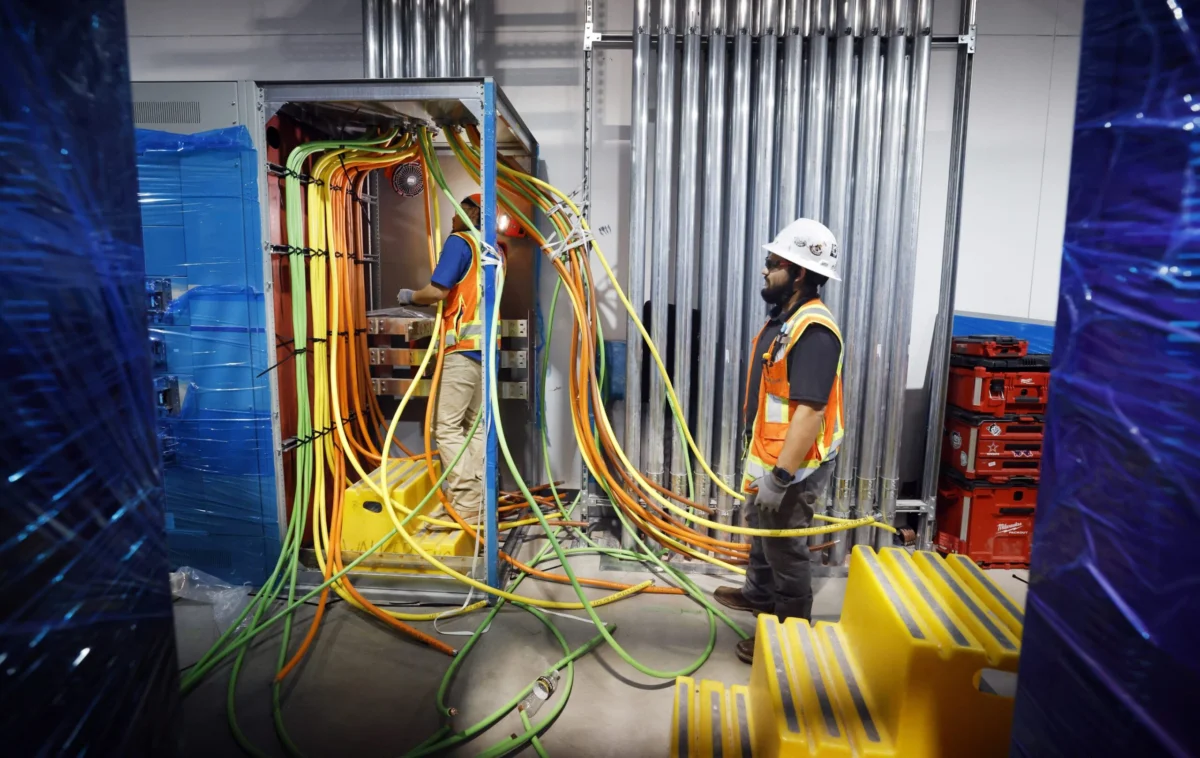
The AI-Driven Labor Shift: From Desk Jobs to Data Centers as Skilled Trades Surge.
The burgeoning landscape of artificial intelligence is sending ripples of anxiety and opportunity across professional sectors, igniting a significant reevaluation of career paths and workforce priorities. While successive warnings about AI’s potential to automate vast swaths of entry-level white-collar work have created a palpable sense of unease in offices and college campuses nationwide, leading to large-scale layoffs that underscore these concerns, a parallel and equally powerful trend is reshaping the labor market. This shift is pivoting demand sharply towards specialized skilled trades, particularly those essential for building and maintaining the foundational infrastructure of the AI era: data centers.
The Looming Shadow of AI Automation on White-Collar Roles
The past few years have witnessed a dramatic acceleration in AI capabilities, particularly with the advent of generative AI models like ChatGPT in late 2022. This technological leap has fueled widespread speculation and, increasingly, concrete instances of job displacement in traditional white-collar fields. Roles in areas such as legal research, financial analysis, administrative support, content creation, and even certain aspects of software development are now considered vulnerable to automation. Reports from institutions like Anthropic, a leading AI research firm, have highlighted the potential for AI to automate tasks across law, business, finance, and management, intensifying the pressure on workers in these sectors.
Numerous technology firms, including giants like Google, Microsoft, Amazon, and Meta, have executed significant layoffs, often citing the pursuit of "efficiencies" enabled by AI. While some economists have coined the term "AI-washing" to suggest that some companies may be using AI as a convenient justification for broader cost-cutting measures, the reality for thousands of workers is a painful and abrupt end to their employment. These layoffs, while not yet fully reflected in broader macroeconomic data — which still shows robust job growth and low unemployment in some regions — have undoubtedly altered perceptions of job security in previously stable white-collar professions. The perception of vulnerability, irrespective of the precise causality, is a powerful motivator for career reconsideration.
The AI Infrastructure Boom: A New Economic Engine
Paradoxically, the very technology that threatens some jobs is simultaneously creating an unprecedented demand for others. The AI revolution is underpinned by a massive global buildout of data centers – the physical infrastructure required to house the powerful servers, networking equipment, and cooling systems that enable AI models to function. This buildout represents an enormous investment, with some estimates placing the U.S. data center expansion alone at nearly $700 billion. Economists, including Harvard’s Jason Furman, have identified this surge in data center construction as a primary driver of current GDP growth, indicating its profound impact on the national economy.
These modern data centers are colossal undertakings, often compared in scale to small cities. For instance, some new facilities are projected to be four times the size of Manhattan’s Central Park. Their construction, commissioning, and ongoing maintenance require a vast and specialized workforce. This is where the demand for skilled trades converges with the future of technology.
"White-Collar Trade Jobs": A Hybrid Career Path Emerges
Against this backdrop of anxiety and opportunity, a new category of "white-collar trade jobs" is emerging. Carrie Charles, CEO of Broadstaff, a prominent staffing and recruiting firm that works with Fortune 500 companies such as Verizon and Oracle, is at the forefront of identifying and articulating this trend. Charles notes a significant surge in demand for skilled electricians and technicians, roles that are integral to the AI infrastructure buildout.
She describes these roles as a unique hybrid, combining the technical acumen traditionally associated with white-collar work with the hands-on, practical application of a trade. "It’s almost like a white-collar trade job," Charles told Business Insider, referring to technician roles. "It’s a technical role, but you’re not sitting all day long." This blend offers a compelling alternative for laid-off tech workers or those seeking greater stability and practical engagement. These positions require not only manual dexterity and an understanding of physical systems but also a strong grasp of complex technical specifications, often involving advanced computing, networking, and sophisticated cooling technologies.
Lucrative Compensation and Robust Job Growth
The financial incentives for these skilled trade roles are increasingly attractive, rivaling or even surpassing salaries in some entry-level white-collar positions. According to Glassdoor estimates, advanced technicians can command salaries up to $95,000, with a median salary hovering around $71,000. For senior skilled electricians, particularly those with specialized knowledge crucial for data center operations – such as liquid cooling systems, fiber optic cabling, and high-voltage power distribution – earnings can easily exceed six figures. Charles further specifies that highly specialized electricians in data centers can earn upwards of $300,000 annually, a compensation level comparable to junior-level roles in specialized medicine or finance. This substantial earning potential, combined with the tangible nature of the work, makes these roles highly appealing.
Beyond individual salary figures, the broader market for skilled trades is experiencing unprecedented growth. An analysis of over 50 million job listings by recruiting firm Randstad, conducted since late 2022 (around the time ChatGPT launched), revealed a dramatic increase in demand across various trades directly linked to the AI buildout:
- Robotics Technicians: Demand has more than doubled.
- HVAC Engineers: Demand increased by 67%.
- Construction Roles: Grew by 30%.
The Randstad report emphasized that demand for some trades is growing three times faster than for professional roles, many of which face the threat of AI automation. The Bureau of Labor Statistics (BLS) projects a "much faster than average" job growth for electricians, forecasting approximately 81,000 job openings annually through 2034. These statistics paint a clear picture of a booming sector with long-term stability and high demand.
The Great Pivot: White-Collar Workers Embrace the Trades
The shifting dynamics in the labor market are not going unnoticed by the workforce. A significant cultural and professional pivot is underway, with a growing number of white-collar professionals reconsidering traditional desk jobs in favor of the trades. A 2025 report from job site FlexJobs found that a remarkable 62% of white-collar workers would be willing to leave their office jobs for a trade role if it offered better stability and pay. This willingness to change reflects a deeper anxiety about job security and a desire for more tangible, resilient career paths.
This sentiment is particularly strong among younger generations. Research from SupplyHouse indicates that approximately one in four Gen Z individuals are seriously considering or actively pursuing a career in the trades, consciously opting out of traditional white-collar paths. This demographic often associates associate-level desk jobs with burnout, instability, and mental health challenges, viewing skilled trades as a viable and more satisfying alternative. The tangible nature of the work, the clear career progression, and the immediate impact of their efforts appeal to a generation seeking purpose and stability.
Industry and Educational Initiatives to Bridge the Talent Gap
Recognizing the critical shortage of skilled labor, major corporations and educational institutions are stepping up to create training pipelines and invest in workforce development. This collaborative effort is essential to meet the burgeoning demand for AI infrastructure.
- Meta and CBRE’s LevelUp Program: In a significant development, Meta, a leading force in AI development, partnered with real estate firm CBRE to launch "LevelUp." Announced in early 2026, this multiyear program aims to recruit and train thousands of technicians specifically for building Meta’s extensive network of data centers across the U.S. This initiative highlights the direct link between AI giants and the need for a robust skilled workforce.
- BlackRock’s $100 Million Investment: Global investment management firm BlackRock has committed $100 million to train plumbers, electricians, and HVAC technicians. This substantial investment from a financial powerhouse underscores the perceived long-term value and stability of these trade professions.
- Lowe’s $250 Million Commitment: Home improvement retail giant Lowe’s is investing an even larger sum, $250 million, into similar training programs for skilled tradespeople, including electricians, plumbers, and carpenters. As a company deeply embedded in home and construction industries, Lowe’s understands the foundational importance of these skills.
- Mike Rowe Foundation Scholarships: Celebrity TV host Mike Rowe, a long-time advocate for skilled trades, is actively contributing through his foundation, offering $10 million in scholarships to individuals pursuing trade school education. His efforts aim to destigmatize vocational training and encourage more people to consider these essential careers.
These initiatives are crucial for alleviating the dire talent shortages that currently pose a major roadblock to the rapid expansion of AI infrastructure. A Broadstaff report earlier this year explicitly stated, "Talent shortages are already affecting construction schedules, commissioning timelines, and long-term operational reliability." This sentiment is echoed across the industry.
The Bottleneck: A Severe Scarcity of Specialized Talent
The gravity of the talent shortage cannot be overstated. Sander van’t Noordende, CEO of Randstad, the world’s largest recruitment firm, articulated this concern to CNBC, identifying the scarcity of skilled labor as the primary bottleneck in the entire AI industry. "Ultimately, the real constraint on global tech growth isn’t solely related to a shortage of microchips, energy, or capital," he stated. "It is the severe scarcity of the specialized talent required to build it."
This acute shortage has far-reaching implications. It could slow down the pace of AI development, increase costs for companies, and potentially hinder broader economic growth fueled by technological advancements. The intricate demands of modern data centers, which include managing complex electrical grids, advanced cooling systems (like liquid immersion cooling), fiber optic networks, and sophisticated security protocols, require a highly specialized and continually updated skill set. Traditional vocational training programs may need significant upgrades to meet these advanced requirements, necessitating ongoing investment in education and on-the-job training.
Broader Economic and Societal Implications
The ongoing shift towards skilled trades driven by AI infrastructure has profound implications beyond individual career choices. Economically, it represents a significant investment in tangible assets and a diversification of the job market, potentially making economies more resilient to purely digital disruptions. It underscores the continued importance of physical infrastructure in an increasingly digital world.
Societally, this trend challenges long-held perceptions about the prestige and value of "blue-collar" versus "white-collar" work. As trades become more technologically advanced, better compensated, and more secure, they are gaining newfound respect and appeal. This could lead to a revitalization of vocational education and a broader reevaluation of career pathways in secondary and higher education. It also highlights the need for continuous learning and adaptability in the workforce, as technological advancements will continue to reshape job roles across all sectors.
In conclusion, while the rise of AI presents undeniable challenges to certain white-collar professions, it simultaneously illuminates a clear and lucrative path for skilled trades. The massive data center buildout is not just an economic engine; it is a catalyst for a fundamental reshaping of the labor market, ushering in an era where hands-on technical expertise is not only highly valued but indispensable to the future of technology itself. The pivot from desk jobs to data centers is more than a trend; it is a critical evolution in the global workforce landscape.




Related Posts

‘We should absolutely be concerned about non-college-educated men today’: higher rents, living at home, falling out of the labor market | Fortune

Southeast Asia Navigates Worst Energy Crisis in Decades, Pivoting to Russia Amidst Hormuz Blockade