
The Managed Services Market Enters a New Era Defined by AI, Talent Shortages, and Evolving Client Demands
The managed services (MS) sector, a cornerstone of modern IT infrastructure for businesses of all sizes, is undergoing a profound transformation. While overall demand for outsourced IT support and strategic guidance remains robust, the landscape has shifted dramatically. The days of securing substantial, long-term IT contracts based solely on foundational helpdesk services and basic infrastructure management are rapidly becoming a relic of the past. Emerging trends, notably the pervasive influence of artificial intelligence (AI), a deepening talent crisis, and a discernible contraction in the average size of initial client deals, are collectively reshaping the strategies and operational models of managed service providers (MSPs) worldwide. This evolution is underscored by Kaseya’s recently published "2026 State of the MSP Report," a comprehensive analysis derived from a global survey of over 1,000 MSPs, offering critical insights into the industry’s current crossroads.
The report paints a clear picture: growth remains an achievable objective, but the pathway to earning that growth is becoming significantly more arduous. A striking 71% of surveyed MSPs identified acquiring new customers as their paramount business challenge. This figure dwarfs all other operational concerns, highlighting the intense competition and the increasing difficulty in differentiating and securing new client engagements. This competitive pressure is further exacerbated by the nature of new client acquisition. A significant 33% of new clients are not entirely new to outsourcing IT functions but are "switchers," actively moving away from an incumbent MSP in favor of a new provider. This dynamic intensifies the battle for market share and places a premium on MSPs that can demonstrably offer superior value, specialized expertise, and forward-thinking solutions.
High Demand, Complex Monetization: The AI Paradox
Artificial intelligence, once a prominent topic of industry discussion, has now firmly cemented its position as a critical market determinant. The "2026 State of the MSP Report" reveals that nearly half of all MSPs (48%) cited AI and automation as the top client need for the upcoming year. This places AI’s perceived importance ahead of historically dominant areas such as cybersecurity and data backup, signaling a significant shift in client priorities and expectations. Businesses are increasingly looking to leverage AI for enhanced efficiency, improved decision-making, and innovative service delivery.
However, a substantial gap persists between client demand for AI-powered solutions and the current revenue generation capabilities of MSPs in this domain. Despite the burgeoning client interest, a mere 13% of MSPs report that AI currently represents a meaningful source of revenue. This disconnect suggests that while MSPs recognize the imperative of AI adoption, they are still in the early stages of developing and effectively monetizing AI-driven services. The challenge lies not only in implementing AI technologies but also in articulating their tangible business value and integrating them into profitable service offerings.
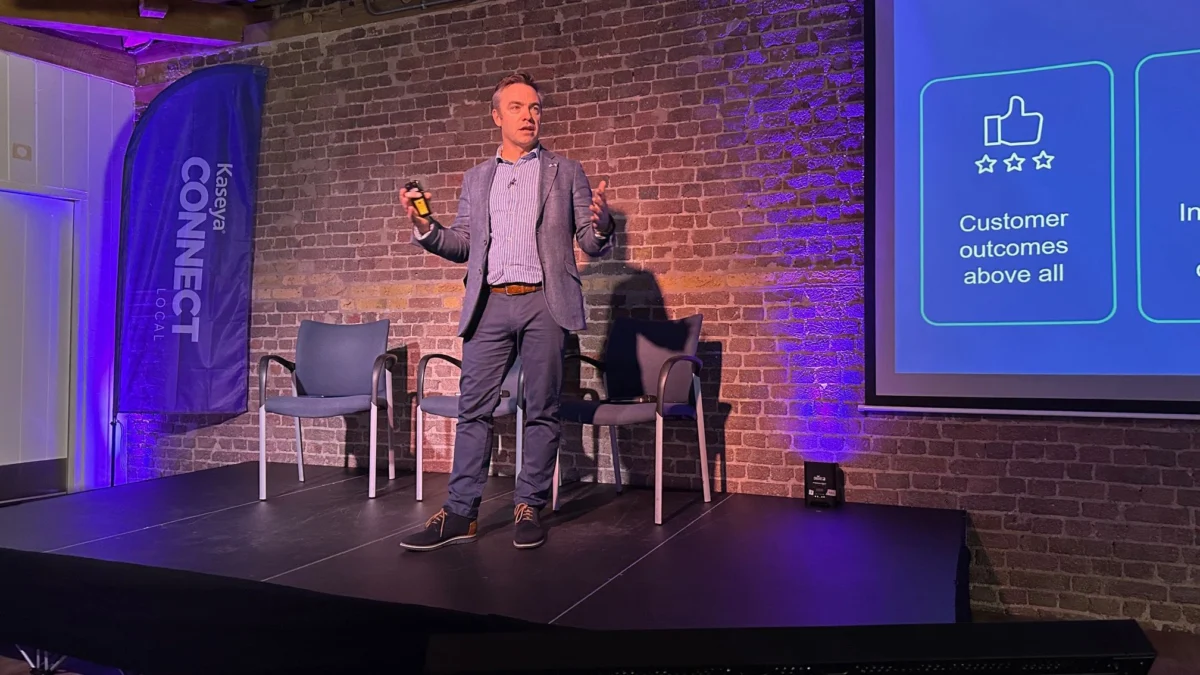
Greg Jones, Kaseya’s Senior Vice President of MSP Success, elaborated on this trend during a recent ChannelPro event in London. He emphasized that a primary driver for Small and Medium-sized Businesses (SMBs) switching MSPs is not necessarily poor service delivery but rather a perceived lack of essential skills, tools, or technologies required for business advancement. "The number one reason that an SMB will leave an MSP is not because of poor service," Jones stated. "It’s because they don’t offer the skill set, the tools, or the technology that they need to move that business forward." He specifically highlighted the growing client demand for expert guidance on AI integration and robust data compliance strategies, areas where many MSPs are still building their capabilities.
To address this evolving client need and to bolster their own operational efficiency, MSPs are increasingly turning to AI for internal application. The report indicates that a significant 53% of providers are actively utilizing AI to automate repetitive, high-volume tasks. This includes critical functions such as ticket management, software patching, and system monitoring. As MSPs grapple with tightening profit margins and increasing operational complexity, this internal automation is proving indispensable for maintaining competitiveness and scaling operations without a commensurate increase in human resources. This strategic deployment of AI internally allows MSPs to free up skilled personnel to focus on higher-value strategic initiatives and client-facing innovation.
The Erosion of Monolithic Contracts: A Shift Towards Specialization
Perhaps the most striking revelation from Kaseya’s 2026 report is the pronounced compression in average deal sizes. The proportion of MSPs reporting typical annual customer spend exceeding $25,000 has plummeted to 41%, a significant drop from 75% observed in the preceding year. Furthermore, a concerning 24% of MSPs noted that their clients are actively seeking to reduce their overall IT budgets. This trend indicates a fundamental shift in how businesses are procuring and consuming IT services, moving away from large, all-encompassing contracts towards more specialized, focused engagements.
Kaseya executives, however, interpret this not as an indicator of a shrinking market but rather as a natural evolution in service consumption patterns. Dermot McCann, Kaseya’s EVP and General Manager for EMEA and APAC, explained that this phenomenon reflects a growing preference for highly specialized, modular service offerings. "The niches are how they’re trying to stay competitive," McCann remarked. Businesses now often take for granted the seamless operation of their day-to-day IT infrastructure. The absence of IT failures or security breaches, while crucial, is no longer a direct driver for client praise or contract renewal in the same way it once was. Consequently, MSPs are compelled to creatively "unbundle" their service portfolios to demonstrate continuous, targeted, and demonstrable value to their clients. This could manifest as specialized engagements in areas like co-managed IT services, where an MSP partners with an in-house IT team, or compliance-as-a-service, where providers focus on specific regulatory adherence.
The report’s findings strongly corroborate this shift in client expectations and the resulting pressure on MSPs. A notable 19% of MSPs now report experiencing difficulty in quickly demonstrating value to their clients, a significant increase from the 10% reported in the previous year. This heightened challenge underscores the need for MSPs to move beyond simply maintaining systems and instead focus on showcasing tangible business outcomes and return on investment.
Compounding the pressure of customer acquisition and value demonstration is the escalating difficulty in fulfilling the demand for these services. The report identifies a critical shift in the primary operational bottleneck for MSPs. The limitation is no longer primarily rooted in software tool capabilities but has decisively moved towards human capital constraints. The number of MSPs reporting challenges in finding and hiring skilled IT technicians has seen a substantial year-over-year increase, rising from 9% to 16%. With the talent pool for specialized IT skills becoming increasingly scarce and expensive, MSPs are faced with a strategic imperative. They must either significantly increase their reliance on AI-driven automation to scale their existing workforce’s capacity or turn to outsourced Network Operations Center (NOC) and Security Operations Center (SOC) services to bridge the talent gap and ensure continuous service delivery.
Cybersecurity and BCDR: Enduring Pillars of MSP Value
Despite the disruptive forces of AI and the contraction in deal sizes, the foundational pillars of the managed services model remain remarkably resilient. Cybersecurity and Business Continuity/Disaster Recovery (BCDR) continue to serve as the most dependable engines for sustained revenue growth within the MSP sector. A substantial 71% of MSPs reported year-over-year revenue growth in their cybersecurity practices, indicating that the demand for robust security solutions remains exceptionally high. Concurrently, 50% of MSPs witnessed corresponding growth in their BCDR service offerings, underscoring the continued importance of data protection and operational resilience for businesses.
The future leaders of the MSP market will be those who can effectively integrate these core security strengths with the operational efficiencies offered by modern technologies. The ability to deliver unwavering security and reliable disaster recovery, coupled with the agility to adapt to new technological demands and evolving client needs, will be the defining characteristic of successful MSPs in the coming years.
"The MSP market is maturing, and rising competition is forcing providers to rethink how they grow," stated Dan Tomaszewski, Executive Vice President of Channel at Kaseya. "The strongest MSPs are tightening their operations, prioritizing efficiency, and using data to clearly prove their value to customers." This strategic tightening of operations, combined with a data-driven approach to value articulation, will be crucial for navigating the complexities of this new era in managed services. The industry is not shrinking, but it is undeniably evolving, demanding greater specialization, technological sophistication, and a more nuanced understanding of client business objectives.
Related posts:




Related Posts

Liverpool FC Leverages Wasabi’s Cloud Storage to Supercharge Digital Engagement and On-Pitch Success

The Hidden Cost of Outdated Technology: Employee Experience and Retention Under Threat