The Evolution of Digital Content Strategy in the Era of Generative Artificial Intelligence and Algorithmic Volatility
The landscape of digital marketing has undergone a seismic shift as the initial novelty of generative artificial intelligence transitions into a complex era defined by algorithmic rigor and a saturated information environment. In 2026, the primary objective of content marketing remains the attraction, engagement, and retention of customers, particularly within the ecommerce sector. However, the mechanisms of attraction have fundamentally changed. Historically, content marketing was synonymous with search engine optimization (SEO); articles were crafted to rank on Google, generate organic visits, and feed the top of the sales funnel. Today, that linear path has been disrupted by the rise of Large Language Models (LLMs), zero-click search results, and highly personalized discovery feeds.
As organic traffic across traditional search engines and emerging AI-driven platforms fluctuates, the industry is facing a paradox: while AI has made the production of content significantly cheaper, it has simultaneously increased the difficulty of achieving visibility. The emergence of what industry analysts call "AI slop"—low-value, repetitive content generated without human oversight—has forced major platforms to adjust their algorithms, prioritizing high-quality, structured, and validated information over sheer volume.
The Chronology of the AI Content Revolution
The journey to the current state of content marketing in 2026 began with the widespread release of generative AI tools in late 2022. By 2023, marketers were experimenting with automated drafting to reduce costs. By 2024, the internet was experiencing a "content explosion," where the volume of published articles increased by an estimated 300%, while the average engagement per post plummeted.
In 2025, search engines began integrating "Search Generative Experiences" (SGE), which provided direct answers to users, reducing the need for them to click through to websites. This led to the "Zero-Click Era," where information was consumed directly on the search results page. By early 2026, the saturation reached a breaking point. On February 15, 2026, Google rolled out a massive core algorithm update specifically targeting Google Discover and AI-generated feeds. According to DiscoverSnoop, a leading research firm specializing in algorithmic visibility, this update resulted in a significant loss of exposure for several high-traffic domains that relied heavily on unrefined AI content. The update prioritized "E-E-A-T" (Experience, Expertise, Authoritativeness, and Trustworthiness) more aggressively than any previous iteration, effectively penalizing sites that could not demonstrate human-led validation or unique insights.
The Vicious Cycle of AI-Generated Content
The current marketing environment is characterized by a "vicious cycle" that threatens the ROI of digital departments. As traditional organic traffic declines due to algorithm changes and the rise of LLMs like ChatGPT and Claude—which provide answers without directing traffic back to the source—the relative cost of acquiring a single visitor rises. In an attempt to offset these rising costs and falling traffic numbers, many marketers double down on AI to produce even more content at a lower price point.
However, this strategy often backfires. When multiple competitors use the same AI models and similar prompts, the resulting content becomes indistinguishable in tone, substance, and structure. This homogenization contributes to a further decline in search performance, as search engines view the content as redundant. The result is a race to the bottom where the sheer volume of content produced yields diminishing returns, ultimately damaging brand reputation and digital authority.
Data-Driven Insights: Quality vs. Quantity
Recent data suggests that the speed and cost advantages of AI have largely been neutralized because these tools are now accessible to everyone. A 2026 study by The New York Times highlighted this shift through an interactive quiz comparing human-written text with AI-generated rewrites. The results were telling: approximately 50% of readers preferred the AI-enhanced versions, but only when those versions were meticulously refined and structured. This indicates that the differentiator in the current market is no longer the use of AI itself, but the sophistication of its execution.
Furthermore, ecommerce data from the first quarter of 2026 shows that brands focusing on "Information Gain"—a metric that measures how much new, unique information an article provides compared to existing search results—saw a 40% higher retention rate than those producing standard AI summaries. This suggests that while AI can handle the "utilitarian" aspect of writing, the "value-add" must be engineered through a more rigorous production process.

The 12-Step Framework for High-Quality AI Content
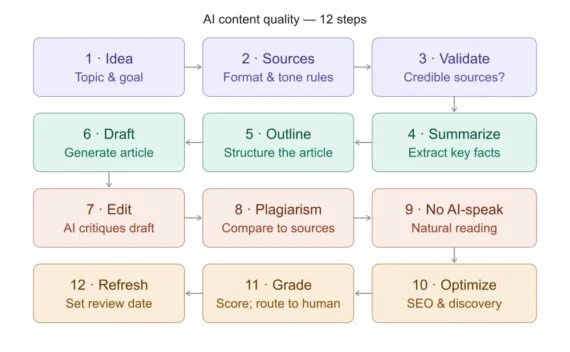
To navigate this challenging environment, industry leaders have moved away from simple "prompt engineering" toward comprehensive content automation systems. The goal is to treat AI not as a writer, but as a component of a multi-stage manufacturing process. The following 12-step framework has emerged as the gold standard for producing AI-assisted content that satisfies both human readers and search algorithms:
- Topic Identification and Research: Utilizing data from search trends, social listening, and customer queries to identify high-intent topics.
- Competitive Analysis: Analyzing existing top-ranking content to identify gaps in information or perspective.
- Primary Data Integration: Incorporating proprietary data, interviews, or unique case studies that AI cannot replicate.
- Detailed Outlining: Creating a logical structure that ensures all user intents are met.
- Initial Drafting (AI-Assisted): Using specialized models to generate a first draft based on the specific data and outline provided.
- Fact-Checking and Validation: A mandatory phase where every claim, statistic, and date is verified by a human editor or a specialized verification tool.
- Tone and Voice Alignment: Refining the language to ensure it matches the brand’s specific persona, avoiding the "generic AI" voice.
- SEO and Entity Optimization: Ensuring the content includes relevant entities and semantic keywords to help LLMs and search engines categorize the information.
- Multimedia Integration: Adding original graphics, videos, or interactive elements that enhance the user experience.
- Human Editorial Review: A final "sanity check" by a professional editor to ensure flow, nuance, and emotional resonance.
- Technical Formatting: Optimizing for mobile, schema markup, and fast loading speeds.
- Performance Monitoring and Iteration: Using real-time analytics to update the content as the topic evolves or as search rankings shift.
Industry Reactions and Expert Perspectives
The shift toward structured AI content has drawn reactions from across the tech sector. Analysts at major digital agencies argue that the role of the "content writer" is evolving into that of a "content strategist" or "AI orchestrator."
"The era of clicking a button and getting a ranking article is over," noted a senior strategist at a leading ecommerce firm. "In 2026, we are seeing a return to editorial standards that resemble traditional journalism. The only difference is that we are using AI to scale the heavy lifting of research and initial drafting. The ‘human in the loop’ is more important now than they were five years ago."
Conversely, some consumer advocacy groups have raised concerns about the transparency of AI-generated content. This has led to calls for standardized "AI disclosure" tags, similar to nutrition labels, which would inform readers about the extent of AI involvement in an article. While not yet legally mandated in all jurisdictions, many top-tier publishers have begun adopting these disclosures to maintain consumer trust.
Broader Implications and the Future of the Funnel
The implications of this shift extend beyond simple marketing metrics. For ecommerce businesses, the "top of the funnel" is becoming more fragmented. Consumers are increasingly discovering products through Google Discover feeds, TikTok-style short-form videos, and direct answers from AI assistants.
To survive, brands must ensure their content is "discoverable" across all these surfaces. This requires a move toward "modular content"—information that can be easily broken down and ingested by various platforms. If an article is well-structured and validated (as per the 12-step framework), it is more likely to be cited by an LLM as a source or featured in a Discover feed.
The long-term impact on the labor market is also significant. While low-level copywriting jobs are diminishing, there is a surging demand for professionals who understand data science, algorithmic behavior, and high-level editorial strategy. The winners in the 2026 economy are not those who generate the most content, but those who generate the most authoritative and useful content.
In conclusion, the advent of ubiquitous AI has indeed been a double-edged sword. It has democratized content production while simultaneously raising the barrier for actual performance. As search engines continue to refine their ability to detect and reward quality, the marketing industry must move past the "utilitarian" use of AI. The transition from AI as a cost-saving tool to AI as a quality-enhancing tool marks the next great chapter in digital marketing. The marketers who will thrive are those who embrace rigorous processes, prioritize human-led validation, and understand that in a world of infinite content, trust is the only currency that matters.




Related Posts

The Strategic Integration of Conversion Rate Optimization Across Multi-Channel E-commerce Ecosystems

Global Ecommerce Evolution 2026: The Rise of Agentic Commerce, Circular Logistics, and Embedded Financial Systems