Strait of Hormuz Plunges into Renewed Uncertainty as Commercial Ship Transits Halt Amid Escalating Tensions
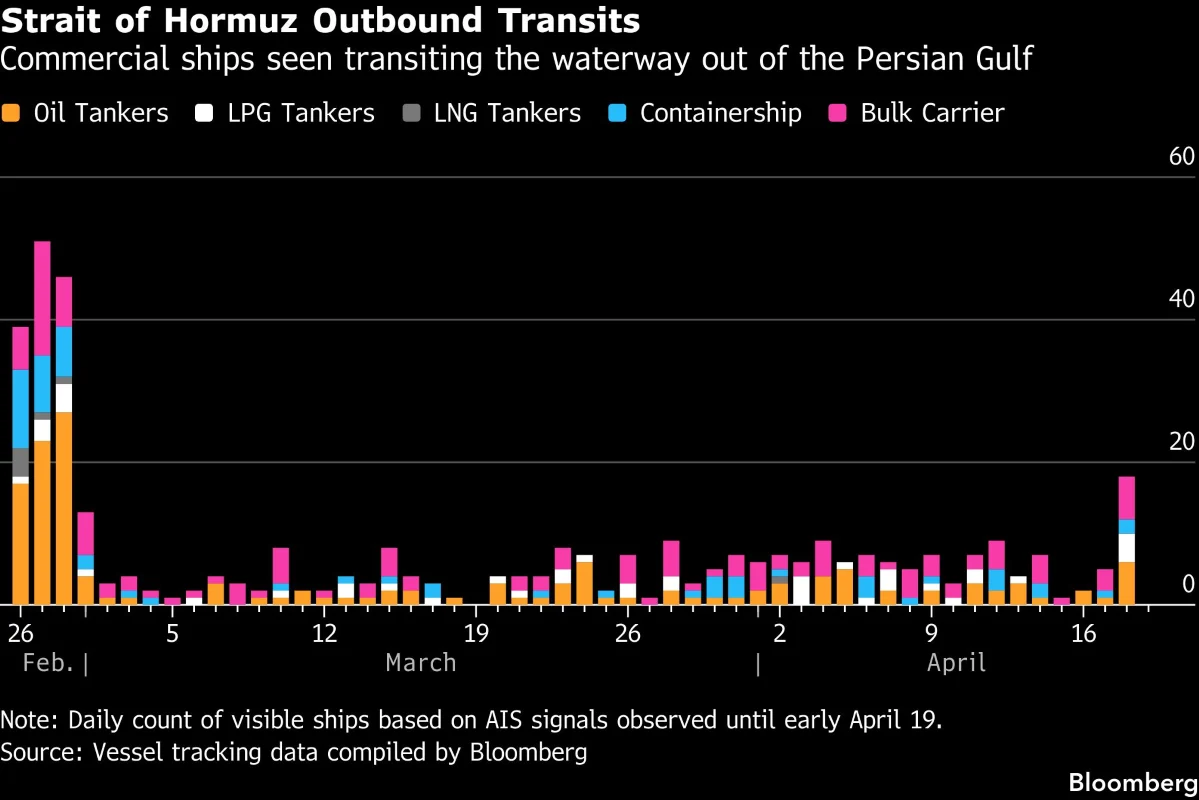
Observed transits of commercial ships through the Strait of Hormuz have come to an abrupt halt following a brief, chaotic surge on April 18, as regional tensions ratcheted higher after vessels came under gunfire in the vital waterway and Iran issued stern warnings against further crossings. The critical chokepoint, through which approximately one-fifth of the world’s oil supply and a significant portion of its liquefied natural gas (LNG) passes, once again faces severe disruption, threatening to exacerbate an already fragile global energy landscape.
According to meticulous tracking data compiled by Bloomberg as of early afternoon in London on April 19, no commercial crossings were observed through the Strait, marking a stark contrast to the previous day’s volatile activity. This sudden cessation of traffic follows a series of dramatic events, including at least 13 oil tankers abandoning attempts to exit the Persian Gulf on April 18, turning back towards their origin. These vessels had initially commenced their journeys after Iran’s Foreign Minister, Abbas Araghchi, announced on April 17 that the strait was officially open for transit. The fleeting window of opportunity quickly dissolved, trapping millions of barrels of oil and substantial quantities of LNG within the Persian Gulf and intensifying fears of prolonged energy crunch impacting the global economy.
A Volatile Chronology of Events
The recent escalation in the Strait of Hormuz is not an isolated incident but rather the latest chapter in a long-standing geopolitical standoff between Iran and the United States, compounded by regional conflicts and a fragile international security environment. The immediate catalyst for the recent disruption unfolded over a tumultuous 48-hour period:
-
April 17: Iran’s Conditional Opening: The situation began to shift on April 17 when Iran’s Foreign Minister Abbas Araghchi declared that the Strait of Hormuz would be open for commercial navigation. This announcement was made within the context of a purported ceasefire between Israel and Hezbollah, Tehran’s powerful Lebanon-based ally. The implication was that Iran was offering a gesture of de-escalation, linking the freedom of navigation to broader regional stability. This statement initially sparked cautious optimism within the shipping community.
-
April 17-18: U.S. Response and Iranian Rejection: Shortly after Araghchi’s announcement, U.S. President Donald Trump publicly reiterated that the Strait was indeed open, emphasizing the principle of freedom of navigation. However, President Trump also unequivocally stated that a pre-existing U.S. Navy blockade of Iranian vessels, particularly those suspected of sanctions evasion or illicit activities, would remain firmly in place. This condition proved to be a critical sticking point for Tehran. Iran swiftly deemed the U.S. stance unacceptable, asserting that the continuation of a naval blockade on its own ships rendered any "opening" of the strait meaningless. Consequently, Iran announced the immediate re-closure of the waterway.
-
April 18: Brief Surge and Dangerous Incidents: Despite Iran’s renewed closure, a brief window of opportunity in the early hours of April 18 saw a flurry of activity. Four tankers, including one significant vessel hauling an estimated 2 million barrels of Saudi and Qatari crude, successfully navigated the outbound passage. In total, 18 commercial ships managed to complete outbound transits during this short period, while 10 ships made inbound crossings, according to Bloomberg’s vessel-tracking data. However, this fragile calm was shattered by reports of hostile interactions. The U.K. Maritime Trade Operations (UKMTO) issued a critical alert, reporting that a tanker had been approached by Iranian Revolutionary Guard Corps (IRGC) gunboats off the coast of Oman before coming under fire. In a separate incident, a container ship was reportedly struck by an unknown projectile, and another commercial vessel reported a splash dangerously close to its hull. These incidents underscored the immediate and severe risks associated with transit, prompting many vessels to reconsider their routes.

-
April 18: Mass U-Turns and Renewed Halt: Following the confirmed incidents of gunfire and the unequivocal re-closure by Iran, the brief surge in traffic rapidly reversed. At least 13 oil tankers, which had initiated their attempts to leave the Persian Gulf, executed U-turns, abandoning their outward journeys and heading back towards the Gulf. This dramatic shift highlighted the extreme caution now dominating maritime operations in the region.
-
April 19: Complete Stagnation: The culmination of these events was the complete absence of commercial ship transits on April 19, as reported by Bloomberg’s tracking data. The waterway, a crucial artery for global trade, had effectively ceased normal operations, pushing the energy market and international shipping industry into a state of heightened alert.
The Enduring Strategic Importance of the Strait of Hormuz
The Strait of Hormuz is more than just a waterway; it is a critical global chokepoint, connecting the oil-rich Persian Gulf to the Arabian Sea and ultimately to the world’s oceans. Its strategic significance cannot be overstated, particularly for global energy markets:
- Global Energy Lifeline: Approximately 21 million barrels per day (bpd) of crude oil, condensate, and petroleum products flowed through the Strait in 2023, representing roughly 21% of global petroleum liquids consumption. This makes it the world’s most important oil transit chokepoint. Major oil producers like Saudi Arabia, Iran, Iraq, Kuwait, Qatar, and the UAE rely heavily on the Strait for their exports.
- LNG Exports: Beyond oil, the Strait is also vital for liquefied natural gas (LNG) exports, particularly from Qatar, the world’s largest LNG exporter. Around one-third of the world’s LNG trade passes through Hormuz, supplying critical energy to markets in Asia and Europe.
- Alternative Routes: While some Persian Gulf countries, notably Saudi Arabia and the UAE, have developed pipeline alternatives to bypass the Strait, their capacities are limited and cannot fully compensate for a prolonged closure or disruption of Hormuz. These pipelines typically serve only a fraction of their total export capabilities, leaving the vast majority dependent on the Strait.
- Economic Vulnerability: Any sustained disruption in the Strait of Hormuz immediately translates into increased shipping costs, higher insurance premiums, and, most critically, spikes in global oil and gas prices. This directly impacts consumer prices, manufacturing costs, and overall economic stability worldwide.
Background Context: A History of Tension and Naval Presence
The current crisis is deeply rooted in decades of US-Iran geopolitical rivalry, which has frequently manifested in the waters surrounding the Arabian Peninsula.
- Post-Revolution Hostility: Following the 1979 Iranian Revolution, relations between Tehran and Washington deteriorated sharply, leading to a prolonged period of sanctions, proxy conflicts, and military posturing.
- The Tanker War (1980s): During the Iran-Iraq War, the Strait of Hormuz became a battlefield in what was known as the "Tanker War." Both sides attacked commercial shipping in an attempt to disrupt each other’s oil exports, leading to significant international intervention, including the re-flagging of Kuwaiti tankers by the U.S. and direct naval confrontations.
- Nuclear Deal and Sanctions: The 2015 Joint Comprehensive Plan of Action (JCPOA), or Iran nuclear deal, offered a brief period of de-escalation, lifting some sanctions in exchange for limitations on Iran’s nuclear program. However, the U.S. withdrawal from the deal in 2018 under the Trump administration and the subsequent re-imposition of "maximum pressure" sanctions reignited tensions, particularly targeting Iran’s oil exports.
- Recent Incidents: In recent years, there have been numerous incidents in and around the Strait, including attacks on tankers attributed to Iran, Iran’s seizure of foreign-flagged vessels, and increased military exercises by both Iran and the U.S. and its allies. The U.S. maintains a significant naval presence in the region, including the Fifth Fleet based in Bahrain, to ensure freedom of navigation and deter hostile actions.
- Broader Regional Instability: The current situation is further complicated by ongoing conflicts and proxy rivalries across the Middle East, including the war in Yemen, political instability in Iraq, and the enduring Israel-Palestine conflict, which often draws in regional and international actors. The mentioned ceasefire between Israel and Hezbollah, a powerful non-state actor backed by Iran, adds another layer of complexity, indicating the interconnectedness of regional security dynamics.
Official Responses and International Reactions
The escalating crisis has drawn sharp reactions from key players and international bodies, reflecting the gravity of the situation.

- Iran’s Position: Iranian officials, while initially signaling an opening, quickly reverted to a hardline stance. Foreign Minister Araghchi’s statements underscore Iran’s demand for reciprocal de-escalation, viewing the continued U.S. naval blockade as a direct challenge to its sovereignty and economic viability. Tehran consistently frames U.S. sanctions and naval presence as acts of economic warfare and aggression, justifying its actions in the Strait as defensive measures or responses to perceived provocations. The gunfire incidents are likely presented by Iran as a consequence of the aggressive U.S. posture and the chaotic environment it creates.
- United States’ Stance: U.S. President Trump’s insistence on maintaining the naval blockade of Iranian vessels while simultaneously declaring the Strait open highlights Washington’s dual objectives: ensuring freedom of navigation for global commerce while simultaneously enforcing its "maximum pressure" campaign against Iran. U.S. officials typically cite international law regarding freedom of navigation and the necessity of preventing illicit activities, including sanctions evasion and weapons proliferation, as justification for its naval presence and interdiction efforts. The U.S. Navy’s Fifth Fleet remains on high alert, emphasizing its readiness to protect commercial shipping.
- United Kingdom’s Concern: The UK Maritime Trade Operations (UKMTO), which monitors maritime activity in the region, played a crucial role in reporting the incidents of gunfire and projectile strikes. The UK, a close ally of the U.S. and a significant maritime nation, consistently calls for de-escalation and adherence to international maritime law. Its reports serve as critical, objective accounts of incidents, informing the global shipping community and advocating for the safety of seafarers.
- International Maritime Organization (IMO): The IMO, the United Nations specialized agency responsible for the safety and security of shipping and the prevention of marine and atmospheric pollution by ships, typically expresses grave concern over any threats to maritime security in critical waterways. While direct statements might not be immediately available, the IMO’s mandate compels it to monitor such situations closely and advocate for safe passage for all commercial vessels, highlighting the severe risks to crew and cargo.
- Shipping Industry and Energy Analysts: Major shipping associations, such as BIMCO and the International Chamber of Shipping (ICS), have undoubtedly issued advisories to their members, warning of increased risks and recommending heightened security protocols, including potential rerouting or delaying transits. Energy analysts, meanwhile, are closely watching crude oil and LNG futures markets, predicting immediate price hikes and increased volatility. They emphasize the supply chain vulnerabilities and the potential for a severe energy crunch if the situation persists.
Broader Impact and Implications
The renewed closure and heightened tensions in the Strait of Hormuz carry significant and far-reaching implications across multiple sectors.
- Global Energy Markets and Economy: The most immediate impact is on global energy prices. With millions of barrels of oil and large quantities of LNG effectively "locked" within the Persian Gulf, the potential for supply shortages will drive up crude oil and natural gas prices. This translates into higher fuel costs for consumers and businesses worldwide, contributing to inflationary pressures and potentially slowing global economic growth, which is already grappling with other challenges. Energy-importing nations, particularly in Asia and Europe, are especially vulnerable to such disruptions.
- Shipping Industry and Insurance: The shipping industry faces a logistical nightmare. Increased "war risk" insurance premiums for vessels operating in the region will skyrocket, making transit prohibitively expensive for some operators. Shipowners may opt for longer, more expensive routes around the Arabian Peninsula, adding days or weeks to voyages and significantly increasing operational costs. The safety of seafarers remains a paramount concern, with crew members increasingly hesitant to sail through dangerous zones.
- Sanctions Evasion and Enforcement: The situation highlights the ongoing cat-and-mouse game between Iran and the U.S. regarding sanctions enforcement. The original article notes that nearly half of the ships that briefly got out on April 18 had links to Iran, and eight of them were sanctioned by the U.S. The fact that none of these sanctioned vessels seemed to have successfully broken the U.S. blockade further out in the open sea, with some anchoring off the UAE or Omani coast, suggests the effectiveness of the U.S. interdiction efforts. The observation that Iran-linked oil tankers often steam from the Persian Gulf without broadcasting signals until they reach distant points like the Strait of Malacca indicates sophisticated attempts at sanctions evasion, making accurate tracking extremely challenging. This "going dark" tactic, as noted by Bloomberg’s tracking methodology, will likely become more prevalent, further obscuring the true volume of trade and increasing the risk of unmonitored activities.
- Geopolitical Stability and Escalation Risk: The exchange of gunfire and the direct confrontation over navigation rights significantly raise the risk of miscalculation and direct military engagement between Iran and the U.S. or its allies. Both sides are operating under high pressure, and any perceived provocation could quickly escalate into a broader conflict, with devastating consequences for regional and global stability. The regional proxy conflicts, such as the Israel-Hezbollah dynamic, remain a critical backdrop, demonstrating the interconnectedness of various flashpoints.
- International Law of the Sea: The crisis also tests the principles of international law regarding freedom of navigation through international straits. While Iran asserts its sovereign rights over parts of the Strait, international law generally guarantees the right of innocent passage. The dispute over the U.S. blockade versus Iran’s right to passage for its own vessels creates a complex legal and diplomatic challenge that could have long-term implications for maritime governance.
Tracking Methodology and Future Outlook
Bloomberg’s diligent tracking efforts, which involve compiling automated positioning signals over a large area covering the Gulf of Oman, the Arabian Sea, and the Red Sea, are crucial for understanding the dynamics of traffic in the region. The methodology accounts for potential transit identification, scrutinizes signal histories to differentiate genuine movement from spoofing (electronic interference falsifying ship positions), and acknowledges the challenge of vessels "going dark." The notes from the original article indicate that transit figures may be revised higher when vessels re-emerge from unmonitored areas, underscoring the opacity inherent in such high-tension environments.
The fate of several vessels remains uncertain. Two Iranian-linked ships are reportedly heading east along the Iranian coast but have yet to reach Chabahar, a port near the Pakistan border where similar journeys have previously halted. The LPG tanker Raine briefly appeared to attempt to run the blockade but turned back toward Hormuz, illustrating the formidable challenge posed by the U.S. naval presence. Separately, four empty European cruise ships made a hurried dash out of the Persian Gulf on April 18, hugging the Omani coastline, indicating that even non-cargo vessels are seeking to evacuate the high-risk zone.
As the Strait of Hormuz remains effectively closed for normal commercial transits, the world watches nervously. The interplay of geopolitical rivalries, economic pressures, and military posturing creates an extremely volatile environment. Without a diplomatic breakthrough or a significant de-escalation of tensions, the disruption to global energy supplies and maritime trade could deepen, with ripple effects felt across the world economy for an extended period. The immediate future of this critical chokepoint, and the stability of global energy markets, hangs precariously in the balance.

Related Posts
Agentic AI’s Transformative Impact Reshapes Software Development and Logistics, Demanding Strategic Adaption
IEA Warns of Imminent Flight Cancellations as Europe Faces Dire Jet Fuel Shortage Amid Persian Gulf Conflict