

FinovateSpring 2026 Spotlights Innovations Modernizing Governance, Risk, and Compliance for Financial Institutions.
The landscape of financial services is undergoing a profound transformation, characterized by escalating complexity, rapid technological advancements, and an ever-tightening regulatory grip. In this dynamic environment, governance, risk, and compliance (GRC) functions, once relegated to the "back office" and often perceived as merely operational overhead, have decisively moved to the forefront of strategic imperatives for banks and fintechs alike. They are no longer just about meeting minimum requirements but are now core pillars defining how institutions operate, compete, and achieve sustainable scale. From the relentless evolution of regulatory expectations, spanning anti-money laundering (AML) and data privacy to consumer protection, to the emergence of increasingly sophisticated cyber threats, fraud schemes, and intricate operational risks, financial institutions face continuous pressure to maintain robust control frameworks while simultaneously fostering innovation. The delicate balance between agility and security has become paramount.
The Evolving Landscape of Financial Risk and Compliance
The journey of GRC from a reactive, manual process to a proactive, technologically driven discipline has been spurred by several converging factors. Post-2008 financial crisis, a wave of stringent regulations emerged globally, including Dodd-Frank in the U.S., Basel III internationally, and a host of regional directives like GDPR in Europe and various data residency laws. These regulations mandated greater transparency, accountability, and robust risk management practices. As financial institutions embarked on digital transformation initiatives, embracing cloud computing, open banking APIs, and artificial intelligence (AI), new vectors of risk materialized. Data breaches became more common and costly, estimated to reach an average of $4.45 million per incident in 2023, with financial services being a prime target. The sheer volume and velocity of transactions, coupled with the complexity of global operations, rendered traditional, siloed GRC approaches inadequate.
By 2026, the adoption of AI and machine learning (ML) within financial services is expected to be near ubiquitous, offering immense opportunities for efficiency and personalized services but also introducing novel risks related to model bias, explainability, and ethical considerations. Regulators are increasingly scrutinizing the ethical deployment and governance of AI models, demanding robust validation and monitoring frameworks. Moreover, the global nature of finance means institutions must navigate a patchwork of disparate regulatory regimes, making consistent compliance an enormous challenge. The cost of compliance continues to soar, with some estimates suggesting that large financial institutions spend upwards of 10-15% of their operational budget on GRC-related activities. This financial burden, coupled with the potential for massive fines for non-compliance – which have run into billions of dollars for major banks in recent years – underscores the critical need for more efficient, intelligent, and scalable GRC solutions.

FinovateSpring 2026: A Hub for GRC Innovation
Against this backdrop of heightened stakes and complex demands, industry events like FinovateSpring 2026 serve as critical platforms for showcasing the cutting-edge innovations poised to redefine GRC. Held annually, Finovate events are renowned for their unique demo-centric format, providing an unparalleled opportunity for financial technology companies to present their solutions directly to an audience of banks, credit unions, investors, and media. The focus this year on GRC highlights its elevated status, moving beyond a niche area to a central theme reflecting its strategic importance. Attendees are eager to discover how next-generation technologies can help them move away from fragmented, labor-intensive processes towards integrated, automated, and predictive GRC frameworks.
At FinovateSpring 2026, a select group of pioneering companies is demonstrating how financial institutions can fundamentally modernize governance, streamline compliance operations, and manage risk more effectively across their entire organization. These innovations promise to usher in a new era of proactive, automated, and scalable GRC, enabling banks to not only meet regulatory obligations but also to leverage strong GRC as a competitive differentiator. Below are five exemplary companies presenting solutions that are instrumental in helping financial institutions navigate this complex environment.
CRIF: Modernizing Credit Risk and Decisioning
CRIF, a global leader headquartered in Italy and founded in 1988, has long been at the forefront of credit bureau services and decision intelligence. At FinovateSpring 2026, CRIF showcased its comprehensive suite of analytics and decisioning platforms, designed to empower financial institutions to make smarter, faster, and more transparent lending decisions. In an era where speed to market and precision in risk assessment are critical, CRIF’s technology allows banks and lenders to rapidly design, test, and deploy sophisticated credit strategies.
What distinguishes CRIF’s offering is its ability to seamlessly integrate data, advanced analytics, and robust governance into a single, cohesive framework. The platform features intuitive no-code strategy design capabilities, enabling business users – not just IT specialists – to configure and manage credit policies. This democratizes the decision-making process, allowing for quicker adaptation to market changes and regulatory shifts. Furthermore, CRIF provides real-time simulations with key performance indicator (KPI) validation, giving institutions the foresight to understand the potential impact of new strategies before full deployment. Crucially, with the increasing scrutiny on algorithmic decision-making, CRIF’s embedded AI agents support compliant and explainable decisioning, ensuring transparency and auditability, which is vital for maintaining regulatory confidence, particularly in light of emerging AI ethics guidelines from supervisory bodies. Serving a diverse client base from global banks to local credit unions and emerging fintechs, CRIF is a critical enabler for modernizing credit risk management while upholding the highest standards of regulatory adherence.
Rulebase: Scaling Compliance Through Automation
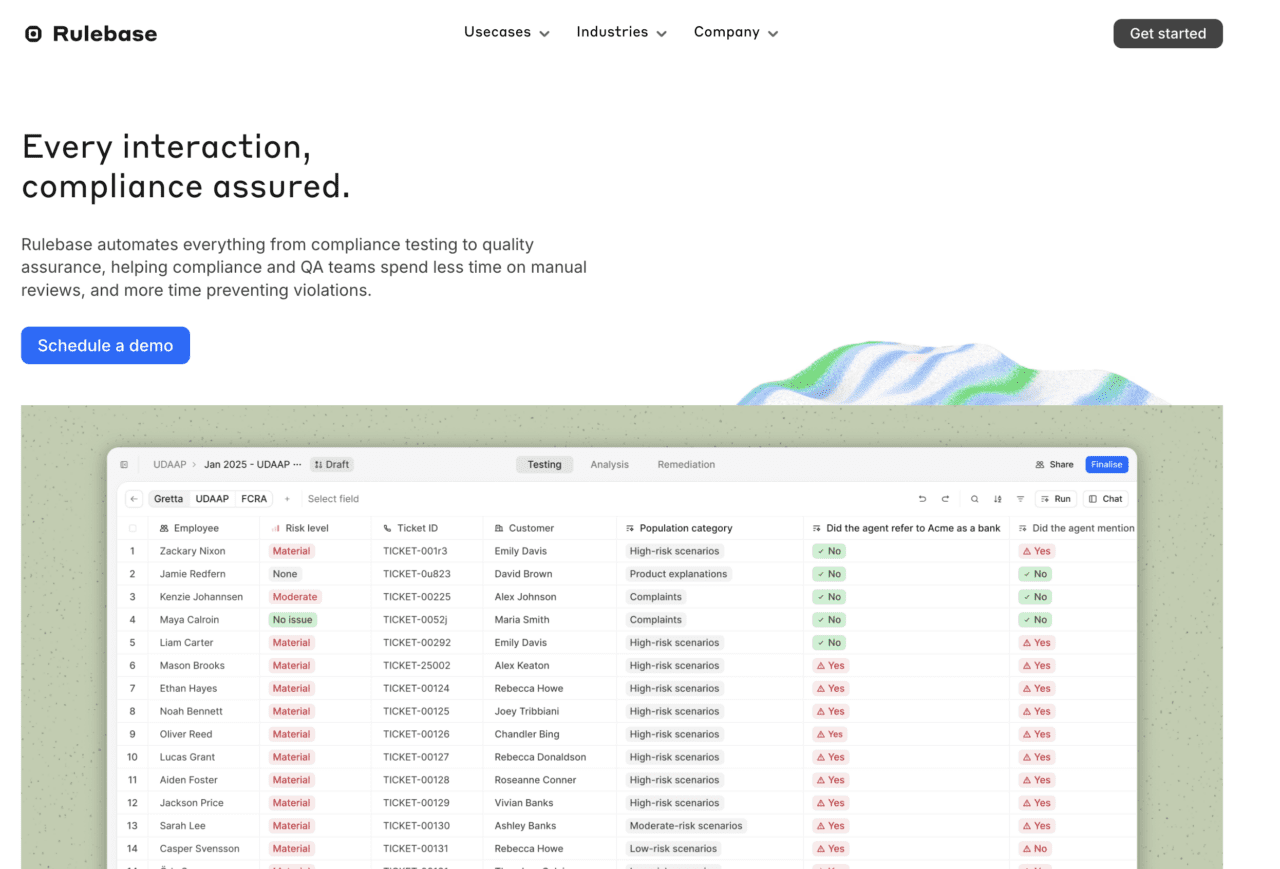
Founded in 2025 and headquartered in New York, Rulebase is a nascent but rapidly impactful company addressing one of the most persistent challenges in compliance: scalability. Traditional compliance testing and quality assurance across customer interactions and internal workflows are notoriously manual, time-consuming, and prone to human error. Rulebase’s innovative platform tackles this head-on by automating these processes, allowing financial institutions to significantly scale their compliance efforts.
The platform continuously monitors activity across various channels, employing advanced algorithms to detect potential violations of regulatory rules or internal policies. Crucially, it automatically generates audit-ready evidence, transforming what was once a laborious, point-in-time exercise into an ongoing, data-driven process. This automation frees compliance teams from the arduous task of manual reviews, allowing them to redirect their expertise to higher-value activities, such as interpreting complex new regulations, developing proactive risk mitigation strategies, and fostering a culture of compliance. By drastically improving the speed and accuracy of compliance checks while simultaneously reducing regulatory risk, Rulebase offers a modern, embedded approach to compliance, making it an integral part of day-to-day operations rather than a periodic burden. This proactive stance is particularly valuable as regulatory bodies increasingly demand evidence of continuous monitoring and control effectiveness.
Winnow: Streamlining Regulatory Intelligence
The sheer volume and complexity of regulatory changes present a daunting challenge for financial institutions globally. Manual research, fragmented information sources, and the constant need for legal interpretation consume vast resources and introduce significant risk. Winnow, founded in 2018 and based in Anaheim, California, offers a powerful solution designed to simplify and streamline regulatory compliance by replacing these traditional, inefficient methods with a centralized, user-friendly platform.
Winnow’s core value proposition lies in delivering tailored, attorney-reviewed regulatory guidance. This eliminates the need for individual institutions to conduct extensive, costly legal research or rely on generic, potentially outdated information. The platform provides precise, actionable insights into compliance obligations, allowing organizations to quickly understand and meet their requirements without the prohibitive time and cost associated with traditional legal counsel or extensive internal research. By reducing the inherent complexity of regulatory interpretation and significantly improving accuracy, Winnow empowers compliance teams. They spend less time deciphering dense legal texts and more time executing against their obligations, implementing necessary changes, and ensuring operational adherence. In an environment where regulatory updates are frequent and penalties for misinterpretation are severe, Winnow provides an efficient, reliable path to staying compliant and agile.
The Electronic Guardian: Fortifying Personal Financial Legacy
While many GRC solutions focus on institutional challenges, The Electronic Guardian, founded in 2019 and headquartered in Pittsburgh, addresses a critical aspect of personal financial governance that banks can leverage to add significant value for their clients. Its platform, The Coop, offers a secure digital repository designed to help individuals organize, protect, and ultimately transfer critical financial and personal information. This innovative service extends beyond mere document storage; it consolidates important documents, digital assets, and critical contacts into a centralized, dynamic system that evolves into a comprehensive estate inventory.
The Coop supports robust legacy planning and ensures asset continuity, addressing a common pain point for individuals and their families: the difficulty of managing and accessing vital information during life transitions or after an unforeseen event. Built with state-of-the-art private encryption and "at rest" recoverability features, The Coop ensures that sensitive information remains both highly secure and readily accessible to authorized parties when it matters most. For banks, credit unions, and even insurance providers, offering The Electronic Guardian’s solution represents a significant value-add. It provides clients with a tangible benefit related to estate organization and long-term asset protection, fostering deeper client relationships and potentially opening new revenue streams. In an increasingly digital world, securing and managing one’s digital legacy is paramount, and The Electronic Guardian offers a trusted solution for this growing need.

Model IQ by Kevin D. Oden & Associates: Mastering Model Risk Management
The proliferation of sophisticated financial models – from credit scoring and fraud detection to trading algorithms and capital planning – has made model risk management (MRM) a critical yet complex area of GRC. Regulatory bodies like the Federal Reserve (SR 11-7), FDIC, and NCUA impose stringent requirements on how financial institutions develop, validate, and govern their models. Model IQ, developed by Kevin D. Oden & Associates, founded in 2018 and based in San Francisco, is an automated platform specifically designed to streamline this intricate process.
Built by quantitative experts ("quants"), Model IQ brings much-needed structure, speed, and consistency to the entire model risk management lifecycle. It automates key processes, from initial model development and documentation to validation, ongoing monitoring, and eventual retirement. This automation significantly accelerates review timelines, which are often a bottleneck in traditional MRM, while simultaneously improving the accuracy and audit readiness of model documentation. The platform ensures compliance with the complex guidelines of SR 11-7 and other regulatory frameworks, providing a clear, auditable trail for every model. Serving a diverse clientele ranging from community credit unions to regional banks and large fintechs, Model IQ offers a scalable approach to governance in an increasingly model-driven industry. As AI and ML models become more pervasive, effective MRM is not just a regulatory necessity but a strategic imperative for managing financial performance and reputation.
The Imperative for Proactive GRC Strategies
The presentations at FinovateSpring 2026 unequivocally underscore that risk, compliance, and governance are no longer peripheral concerns but are absolutely central to a bank’s operations, directly impacting an organization’s ability to innovate, expand, and scale. The sheer volume and velocity of risks faced by financial institutions have reached unprecedented levels. As banks increasingly adopt advanced AI, expand their digital channels, and operate across an intricate web of international regulatory environments, the traditional reliance on manual processes and siloed systems has become unsustainable. These outdated approaches are simply incapable of keeping pace with the dynamic nature of modern financial risk.

Driving Operational Efficiency and Competitive Edge
The solutions showcased – ranging from automated compliance testing and transparent decision-making platforms to streamlined model risk management and integrated regulatory intelligence – offer banks a powerful pathway to stay not just abreast, but ahead of regulatory expectations. By embracing these technologies, financial institutions can operate with greater efficiency, reduce operational costs, and mitigate the risk of costly penalties and reputational damage. An estimated 60% of GRC tasks are still performed manually or semi-manually across the industry, highlighting a vast opportunity for automation to unlock significant efficiency gains. Beyond mere compliance, these platforms contribute to a more agile and resilient organization. Faster, more accurate credit decisions (CRIF), continuous compliance monitoring (Rulebase), clear regulatory guidance (Winnow), and robust model governance (Model IQ) all translate into improved operational performance and a stronger competitive position. Institutions that proactively adopt these sophisticated GRC tools can allocate their human capital more strategically, focusing on innovation and customer service rather than rote compliance tasks. This reduction in the operational burden on internal teams is a significant benefit, fostering a more engaged and productive workforce.
Ensuring Trust and Future-Proofing Financial Institutions
Furthermore, the integration of client-centric GRC solutions, such as The Electronic Guardian, exemplifies a broader trend towards leveraging GRC capabilities to enhance customer value and trust. For end-users, having a secure, organized, and easily manageable repository for their critical financial and personal documents is invaluable for both security and organization. Financial institutions that offer such tools, whether as a direct service or as an added benefit, not only open up potential new revenue streams but also provide clients with a compelling reason to associate their bank with safety, security, and forward-thinking service. In a world where trust is the ultimate currency, particularly in financial matters, providing tools that safeguard a client’s digital legacy can significantly strengthen brand loyalty and reputation.
In conclusion, the innovations presented at FinovateSpring 2026 underscore a pivotal shift in financial services: GRC is no longer a cost center to be minimized but a strategic investment that drives operational excellence, fosters innovation, and builds enduring trust. Financial institutions that embrace these proactive, automated, and scalable GRC solutions will be better positioned to navigate the complexities of the modern financial world, ensuring resilience, fostering growth, and ultimately, future-proofing their operations for decades to come.
Related posts:




Related Posts

Synctera Acquires Cable to Cement Leadership in BaaS Compliance, Ushering in a New Era of Continuous, Verifiable Financial Risk Management.

Heritage Family Credit Union Fortifies Operations and Risk Management Through Strategic Partnership with Quinte Financial Technologies.