

Mastering the Sprint Retrospective: Strategies for Agile Team Improvement and Enhanced Project Outcomes
Sprint retrospectives, designed as crucial forums for continuous improvement within Agile methodologies, frequently fall short of their transformative potential, devolving into mere rituals rather than drivers of progress. This challenge underscores a critical need for structured formats and adept facilitation, without which these sessions risk becoming unproductive and disengaging. To address this, expert Scrum Masters and Agile coaches are sharing proven techniques and real-world experiences aimed at revitalizing sprint retrospectives, ensuring they deliver tangible improvements and foster genuine team growth.
The Foundational Role of Retrospectives in Agile Frameworks
At its core, a sprint retrospective is a dedicated meeting where a Scrum team reflects on a recently concluded sprint to identify areas of success and opportunities for improvement. The ultimate objective is to pinpoint at least one actionable change the team commits to implementing in the subsequent sprint. This commitment to continuous adaptation is a cornerstone of the Agile philosophy, emphasizing iterative development and responsive adjustment.
The concept of a "sprint," typically a one to four-week timeboxed period, is central to the Scrum framework, widely adopted by software and product development teams. The retrospective concludes each sprint, following a review of accomplished work, and serves as a vital feedback loop for the team’s internal processes and collaborative dynamics. Without effective retrospectives, teams risk repeating mistakes, fostering frustration, and undermining the very principles of agility they aim to embody.

Expert Insights Driving Best Practices
The insights for optimizing sprint retrospectives come from a cadre of seasoned professionals, including Rebecca Federspiel, Associate Director and Head of Product at Scrum Alliance; Steve Fenton, Director of Developer Relations at Octopus Deploy; Michael Taylor; and Richard Demeny. These experts bring years of facilitation experience, offering practical formats and techniques to help teams maximize the value of every retrospective session. Their collective wisdom emphasizes that the success of a retrospective hinges not just on its existence, but on its execution, ensuring it moves beyond a perfunctory meeting to a genuine catalyst for change.
Defining the Sprint Retrospective: Purpose, Participants, and Placement
A sprint retrospective is explicitly a Scrum team meeting, meaning its attendance is intentionally limited to the immediate team members. Key participants include:
- The Scrum Master: The facilitator of the meeting, responsible for guiding the team through the agenda, ensuring adherence to ground rules, and fostering a safe environment for open discussion.
- The Product Owner: Represents stakeholder interests and participates in the discussion regarding team processes and collaboration, particularly as they impact product delivery.
- The Development Team: All individuals directly involved in building the product, whose collective experiences and perspectives are central to identifying improvements.
Crucially, external stakeholders, managers, or other parties are explicitly excluded. This deliberate internal focus is paramount for cultivating psychological safety—an environment where team members feel secure enough to voice concerns, identify inefficiencies, and critique processes without fear of reprisal or judgment. The presence of outside individuals can significantly alter this dynamic, inhibiting candid feedback and reducing the meeting’s effectiveness.
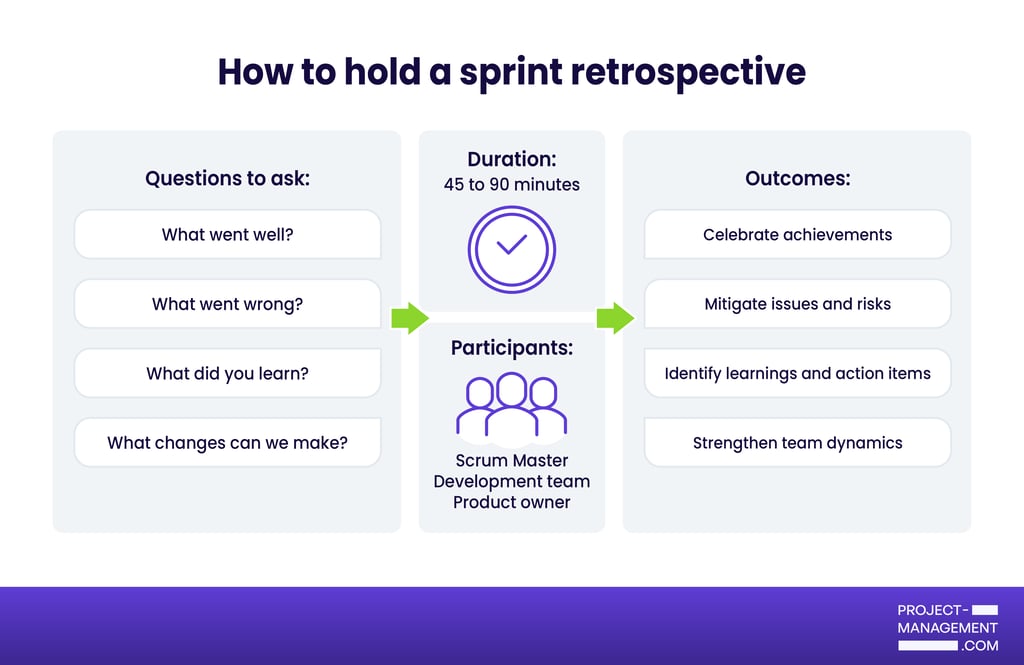
The retrospective is one of the five core Scrum ceremonies. Its timing is strategic: it occurs after the Sprint Review (where the team demonstrates completed work) and before Sprint Planning for the next cycle. This placement ensures that insights from the completed sprint are fresh and can directly inform the planning of future work. The duration typically ranges from 45 to 90 minutes, scaled to the length of the sprint (e.g., 45 minutes for a one-week sprint, up to 90 minutes for a two-week sprint).
The Indispensable Value of the Retrospective
The sprint retrospective stands out as the only Scrum ceremony solely dedicated to the team’s internal workings and collaborative health. It provides a unique, protected space for teams to reflect on "how" they worked, rather than just "what" they accomplished. This introspection is critical for preventing recurring issues, fostering a culture of continuous learning, and enhancing overall team performance.
Specific benefits derived from an effective sprint retrospective include:
- Continuous Process Improvement: Directly identifies and addresses inefficiencies, bottlenecks, and suboptimal practices.
- Enhanced Team Cohesion: Promotes open communication, builds trust, and strengthens interpersonal relationships by providing a platform for shared reflection and problem-solving.
- Adaptability and Resilience: Equips teams to quickly adapt to changing circumstances, learn from failures, and reinforce successful strategies.
- Increased Morale and Ownership: When team members see their feedback leading to tangible changes, it boosts morale, increases engagement, and fosters a sense of collective ownership over their processes.
- Risk Mitigation: Uncovers potential risks or emerging problems early, allowing the team to devise proactive solutions.
A Structured Approach: The Five-Step Retrospective Agenda

Running an effective sprint retrospective follows a structured, five-step agenda designed to guide the team from individual reflection to collective action.
- Step 1: Set the Stage (5 minutes): The Scrum Master initiates the meeting by reiterating its purpose: to learn and improve, not to assign blame. Establishing ground rules, such as "What happens in the retro, stays in the retro" and "Be open-minded," is crucial. A brief check-in activity or icebreaker helps gauge the team’s mood and ease them into a collaborative mindset, setting a psychologically safe tone.
- Step 2: Gather Data (10 to 15 minutes): This phase encourages individual reflection before group discussion. Team members consider key questions related to the sprint, often using templates to structure their thoughts. These questions typically cover:
- What went well? (e.g., successful processes, effective collaborations, positive outcomes)
- What did not go well? (e.g., slowdowns, frustrations, miscommunications, underestimated tasks)
- What can we improve? (e.g., process adjustments, tool enhancements, workflow changes)
- Action and commitment: (e.g., specific changes for the next sprint, ownership, follow-up mechanisms, blockers to escalate)
Providing these questions a few days in advance allows team members to come prepared with thoughtful contributions.
- Step 3: Generate Insights (10 to 15 minutes): Once individual reflections are collected (often on a shared digital whiteboard), the Scrum Master facilitates the grouping of similar observations into themes. Team members are encouraged to read their notes aloud, fostering shared understanding and ensuring everyone feels heard. This stage moves beyond simply listing events to understanding the underlying causes and impacts. Techniques like dot-voting can help the team identify the most impactful issues to address.
- Step 4: Decide on Action Items (10 minutes): This is the pivotal step where reflection translates into concrete plans. The team votes on one or two specific, actionable changes to implement in the upcoming sprint. Each action item must have a clear owner and a defined mechanism for tracking its completion and effectiveness, ensuring accountability and follow-through. These actions should be SMART: Specific, Measurable, Achievable, Relevant, and Time-bound.
- Step 5: Close the Retrospective (5 minutes): The Scrum Master summarizes the agreed-upon action items, reiterating commitments, and thanks the team for their active participation. Acknowledging the insights gained reinforces the value of the session and encourages future engagement. Ending on a positive note, perhaps with a quick appreciation round, leaves the team energized and ready for the next sprint.
Diverse Formats for Dynamic Retrospectives
The choice of retrospective format significantly influences the quality and direction of the discussion. Different formats are suited to varying team dynamics and specific challenges. Some of the most widely used include:
- Start/Stop/Continue: A straightforward format where the team identifies actions to "Start" doing, "Stop" doing, and "Continue" doing. This is excellent for teams seeking direct, actionable process changes.
- The Sailboat: A metaphorical approach where the team visualizes their sprint as a sailboat journey. "Wind" represents what propelled them forward (successes), "Anchors" symbolize what held them back (impediments), "Rocks" are potential risks, and "Islands" are future goals. This format encourages a more narrative and strategic discussion.
- The 4Ls (Liked, Learned, Lacked, Longed For): This comprehensive format encourages reflection across four dimensions: what the team "Liked" (positive aspects), "Learned" (new knowledge or skills), "Lacked" (missing resources or support), and "Longed For" (aspirations or desired changes). It provides a holistic view of the sprint experience.
Platforms like Miro, a visual project management tool, offer extensive template galleries (over 1,200 templates) for various retrospective formats, including Mad Sad Glad, Starfish, and Hot Air Balloon. These digital tools facilitate remote collaboration and provide structured canvases for team reflection, making it easier to experiment with different approaches and keep sessions engaging.
Real-World Application: Transforming Team Performance

Observing how other teams leverage retrospectives can inspire tailored approaches. Two examples highlight the power of structured reflection:
- Case Study 1: Remote Software Development Team and Start/Stop/Continue
A remote software development team at a mid-sized SaaS company faced persistent miscommunication issues between developers and the Product Owner. Their Scrum Master introduced the Start/Stop/Continue format, leveraging an online template for asynchronous feedback collection prior to the meeting. During the session, the Scrum Master categorized responses into themes on a shared screen. The team quickly pinpointed that daily stand-ups were excessively long, encroaching on focused work time. They collectively agreed to "stop" using stand-ups for in-depth problem-solving and instead "start" scheduling separate, dedicated sessions for those discussions. By the next sprint, stand-ups consistently concluded within 15 minutes, and the team reported a significant reduction in work interruptions, demonstrating the direct impact of a well-executed retrospective. - Case Study 2: Product Team and the Sailboat Format
A product team within a retail company experienced a plateau in their retrospectives, with discussions becoming repetitive and uninspiring. Their Scrum Master opted for the Sailboat format to inject fresh perspective and energy. The team collaboratively identified "wind" as a recently improved deployment process that had significantly reduced release times, a clear success. Concurrently, they pinpointed "anchors" as unclear acceptance criteria that frequently led to rework late in the sprint. The Sailboat metaphor encouraged a shift from mere venting to proactive problem-solving. Instead of just discussing the problem, the team focused on "cutting the anchor loose," committing to involve the Product Owner earlier in defining acceptance criteria before sprint planning. Within two sprints, the rate of rework visibly declined, and the team reported feeling more aligned and prepared for each sprint cycle.
Common Pitfalls and How to Navigate Them
Even established teams can fall into habits that diminish retrospective effectiveness. As Rebecca Federspiel plainly states, "Retrospectives usually fail for a few predictable reasons: teams don’t feel safe being candid, the conversation turns into blame or venting, and, most often, nothing changes afterward." Understanding these common mistakes is the first step toward overcoming them.
- The Blame Game: Richard Demeny observes that "Blame [games are] quite common, especially when there are deeper interpersonal issues going on between developers." When the focus shifts from problem-solving to finger-pointing, honest dialogue ceases, and the team’s ability to progress is severely hampered. The Scrum Master must actively redirect such conversations, focusing on processes and systems rather than individuals.
- Silence and Self-Protection: Michael Taylor highlights that team members often hold back not out of malice, but "for self-protection. They have concerns that saying it could get them into trouble, make them look bad, get someone else in trouble, [or] make someone else look bad." This lack of psychological safety means crucial issues remain unaddressed, rendering the retrospective ineffective.
- Unaddressed Low Participation: As Demeny points out, "It is okay if someone does not have much to share, but if it becomes a pattern, then it is a problem that must be dealt with." Consistent low participation signals deeper issues, such as disengagement, feeling unheard, or a lack of perceived impact from previous retrospectives.
- Domination by a Few Voices: Steve Fenton notes, "Many Scrum Masters don’t even notice when someone isn’t getting an opportunity to speak, or they over-correct by calling out a quiet person who doesn’t want to speak." An equitable distribution of voice is crucial; otherwise, valuable perspectives are lost, and some team members may disengage. Effective facilitation ensures everyone has a chance to contribute without feeling pressured.
- Lack of Follow-Through: Perhaps the most damaging mistake is when "nothing changes afterward," as Federspiel identifies. If retrospectives consistently end without clear, owned, and tracked action items, they lose credibility, and team participation inevitably drops. The retrospective transforms from a tool for improvement into a meaningless routine.
Expert Recommendations for Maximizing Retrospective Impact
To transform retrospectives into powerful engines of continuous improvement, expert Scrum Masters offer several key recommendations:

- Prioritize Psychological Safety Above All Else: Steve Fenton emphasizes that "Retrospectives only work under conditions of psychological safety. If there are any repercussions for honest participation, there’s no point even attempting to run one." The Scrum Master’s primary role is to cultivate an environment of trust where candor is encouraged and perceived as safe. This involves consistently reinforcing the "Prime Directive" of retrospectives: "Regardless of what we discover, we understand and truly believe that everyone did the best job they could, given what they knew at the time, their skills and abilities, the resources available, and the situation at hand."
- Ensure Actionable, Owned Commitments: Federspiel advises, "Keep the discussion specific and leave with one or two small, owned action items you’ll review at the start of the next retro." Focusing on a limited number of specific, manageable actions, each with a clear owner and a plan for follow-up, dramatically increases the likelihood of successful implementation. This tangible outcome reinforces the value of the retrospective.
- Handle Anonymous Input with Genuine Intent: While anonymous feedback can surface sensitive issues, Michael Taylor cautions that "Anonymous input requires genuine personal safety and privacy, a genuine intent to learn, not blame." The Scrum Master must process anonymous feedback with care, ensuring that the discussion remains focused on systemic improvements rather than individual fault. Any hint of blame, even with anonymous input, can quickly shut down future contributions.
- Maintain Focus and Mitigate Distractions: Richard Demeny stresses the importance of keeping sessions relevant: "It is important to keep the session relevant, which means cutting personal arguments and technical discussions very short." A skilled Scrum Master knows when to redirect tangential conversations, "parking lot" items that require separate discussions, and gently guide the team back to the core purpose of the retrospective. This ensures efficient use of time and prevents the meeting from derailing into unproductive debates.
Broader Implications: Retrospectives as Pillars of Organizational Agility
Effective sprint retrospectives are not merely operational necessities; they are strategic assets for any organization embracing Agile. By consistently fostering a culture of self-reflection and continuous improvement, teams become more adaptable, resilient, and ultimately, more productive. This iterative learning process, institutionalized through regular retrospectives, contributes directly to organizational agility—the capacity to respond rapidly and effectively to market changes, technological advancements, and evolving customer needs.
Beyond immediate project outcomes, robust retrospective practices enhance team morale, reduce burnout by addressing friction points, and empower development teams to take greater ownership of their work environment and processes. In an increasingly dynamic business landscape, the ability to inspect and adapt, driven by insightful retrospectives, becomes a critical differentiator for sustained success.
In conclusion, the sprint retrospective, when facilitated with skill and purpose, transcends its definition as a mere meeting. It transforms into a vital feedback loop, a catalyst for team growth, and a cornerstone of organizational learning. By avoiding common pitfalls and embracing expert-recommended strategies, teams can unlock the full potential of these sessions, ensuring continuous improvement and contributing significantly to enhanced project outcomes and overall business agility.



Related Posts

PMI Unveils Major Overhaul of PMP Certification Exam for 2026, Signifying a New Era for Project Leadership

Choosing the Best Workflow Management Software for Enhanced Operational Efficiency