Etsy Leverages Artificial Intelligence and Agentic Commerce to Drive Revenue Growth Amid Fluctuating Market Conditions
The global e-commerce landscape is currently undergoing a seismic shift as major players transition from traditional search-based models to sophisticated, AI-driven ecosystems. Etsy, the prominent marketplace for unique and creative goods, has positioned itself at the forefront of this evolution. Despite facing a period where gross merchandise sales (GMS) have seen a decline, the company has successfully leveraged artificial intelligence (AI) to bolster its revenue streams and enhance operational efficiency. This strategic pivot focuses on two primary pillars: optimizing search and discovery for consumers and pioneering the frontier of agentic commerce.
By integrating large language models (LLMs) and partnering with tech giants like OpenAI, Google, and Microsoft, Etsy is redefining how buyers interact with its massive inventory of over 100 million listings. The company’s leadership, including CEO Kruti Patel Goyal and CFO Charles Baker, recently outlined these initiatives at a Morgan Stanley technology conference, highlighting how AI is no longer just a backend tool but a central component of the consumer experience. As Etsy maintains its position as No. 20 in the Global Online Marketplaces Database, its commitment to "evergreen" priorities like search matching suggests a long-term vision where AI agents handle the complexities of shopping, leaving humans to enjoy the discovery of unique items.
The Strategic Shift Toward AI-Enhanced Search and Discovery
For a marketplace like Etsy, which prides itself on a vast and highly fragmented inventory of handmade, vintage, and custom items, the "matching" problem is the most significant hurdle. Unlike standardized commodities found on platforms like Amazon, Etsy’s products are often one-of-a-kind, making traditional keyword search less effective. CEO Kruti Patel Goyal emphasized that search and discovery remain the core value proposition of any marketplace. To address the "stickiest challenges" of matching buyers with the right products, Etsy has turned to LLMs to develop a deeper understanding of three critical factors: the inventory, the buyer’s history, and the buyer’s immediate intent.
The advancement of AI over the past two years has allowed Etsy to move beyond simple metadata—such as titles and tags—to a semantic understanding of what a product actually is. This means the AI can interpret the aesthetic, the occasion, and the nuance of a listing. When these three aspects are addressed in unison, the value of the platform’s 100 million-plus listings is amplified. Goyal noted that while search has always been a priority, the recent breakthroughs in generative AI have made the technology "a lot better" in just the last twelve months, allowing for a more intuitive and successful user journey.
Understanding Agentic Commerce and the Role of AI Agents
A significant portion of Etsy’s future-proofing strategy involves "agentic commerce." This term refers to a new paradigm in e-commerce where autonomous AI agents—such as those powered by ChatGPT or Google’s Gemini—can perform tasks on behalf of the user. This includes searching for products, comparing prices, and even executing purchases without the user ever having to visit the merchant’s website directly.
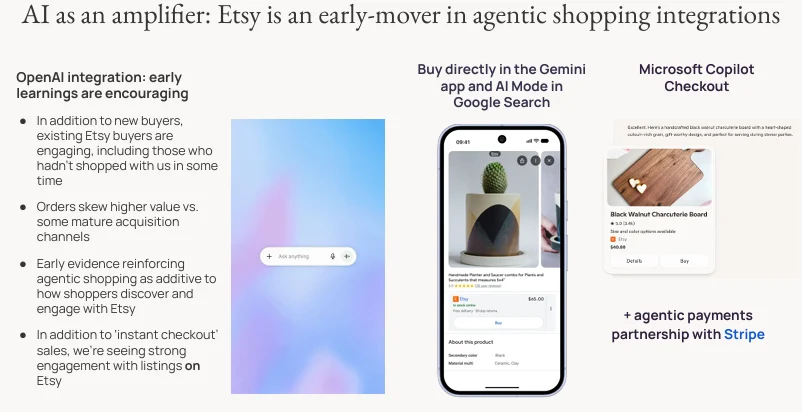
Etsy has leaned into this trend through a high-profile partnership with OpenAI. This collaboration resulted in the launch of "instant checkout" within the ChatGPT interface. This feature allows a user to ask an AI for a gift recommendation, receive a list of Etsy products, and complete the transaction immediately within the chat window. This reduces friction and captures the consumer at the exact moment of intent. Goyal views agentic commerce as a "meaningful potential incremental discovery channel," allowing Etsy to show up where the shopping mission begins, rather than waiting for the buyer to navigate to the Etsy homepage.
A Chronology of Etsy’s Technological Evolution
Etsy’s journey toward an AI-first marketplace has been a multi-year endeavor marked by both experimentation and strategic partnerships.
- 2022–2023: Early Conversational Trials: Etsy experimented with early-stage conversational commerce interfaces. At the time, Goyal admits these efforts were not particularly effective, as the underlying technology lacked the fluidity and reasoning capabilities of modern LLMs.
- 2024: The Generative AI Pivot: As ChatGPT and other generative tools gained mainstream adoption, Etsy began integrating these models into its backend to automate routine tasks for sellers, such as generating product descriptions and optimizing listing photos.
- Late 2024: The OpenAI Partnership: The marketplace announced its collaboration with OpenAI to enable "instant checkout," marking one of the first major integrations of transactional capabilities within a third-party LLM.
- January 2026: Google AI Mode Integration: Etsy announced it would sell directly through Google AI Mode, allowing the Google Gemini agent to browse Etsy listings and facilitate sales.
- March 2026: Public Strategy Disclosure: At the Morgan Stanley technology conference, Etsy leadership confirmed that traffic from agentic AI sources had grown 15 times year-over-year in fiscal Q4, signaling the rapid scaling of this new channel.
Participation in the Agent Payments Protocol (AP2)
To support the rise of agentic commerce, Etsy has joined a prestigious consortium of financial and technology leaders to back Google’s Agent Payments Protocol (AP2). This protocol is designed to standardize how AI agents handle financial transactions securely and efficiently across different platforms. By aligning with partners such as Visa, Mastercard, PayPal, American Express, Coinbase, Salesforce, Shopify, and Cloudflare, Etsy is ensuring that its infrastructure is compatible with the emerging global standards for AI-driven payments.
The AP2 protocol addresses one of the primary barriers to agentic commerce: trust. For a consumer to allow an AI agent to spend money on their behalf, there must be rigorous security protocols and purchase protections in place. Etsy’s involvement in this initiative suggests that the company views the AI agent not just as a search tool, but as a trusted intermediary that will eventually handle a significant portion of global e-commerce volume.

Data Insights: Traffic Growth and Consumer Behavior
While the growth of agentic commerce is impressive, Etsy’s leadership remains grounded in the current reality of the data. CFO Charles Baker pointed out that although traffic from AI agents grew 15-fold in the final quarter of the fiscal year, it still represents less than one percent of Etsy’s total traffic. However, the quality of this traffic is what excites the executive team.
Data revealed that traffic referred by generative AI platforms typically displays:
- Higher Purchase Intent: Users coming from an AI agent have often already completed the "discovery" phase and are ready to buy.
- Increased Average Order Value (AOV): These consumers tend to select higher-priced items or more comprehensive gift sets recommended by the AI.
- Strong Flow-Through: Many users discover an item via an AI agent and then click through to the Etsy platform to "learn more and engage more deeply" with the seller.
Baker noted that customers often seek more information about the story behind a handmade item or the specific shipping policies of a seller—details that AI agents currently summarize but which buyers prefer to verify on the primary site. This "pass-through" traffic helps maintain the human connection that is vital to the Etsy brand identity.
Transforming the Seller Experience and Internal Operations
The benefits of AI at Etsy extend beyond the buyer’s journey. The company is actively applying the same conversational interfaces and LLM capabilities to the seller side of the marketplace. For many Etsy sellers, who are often individual creators or small business owners, administrative tasks like SEO optimization, customer service inquiries, and inventory management can be overwhelming.
Etsy is deploying AI tools to:
- Automate Customer Support: AI can draft responses to common questions, allowing sellers to focus on crafting their goods.
- Optimize Advertising: AI analyzes search queries to better match a seller’s advertised products with the right audience, ensuring a higher return on ad spend.
- Enhance Personalization: On the Etsy mobile app, AI is used to create highly personalized shopping feeds, showing users products that align with their specific tastes and previous browsing habits.
Goyal believes that training consumers to use conversational interfaces on the buyer side will naturally lead to a more efficient experience on the seller side, as both parties become accustomed to interacting with AI-enhanced tools.
Broader Impact and Industry Implications
Etsy’s aggressive pursuit of AI and agentic commerce serves as a blueprint for other specialized marketplaces. In an era where "search" is becoming "answering," marketplaces can no longer rely solely on users typing queries into a search bar. They must be present in the ecosystems where users spend their time—whether that is a chat interface, a social media platform, or a virtual assistant.
The transition from linear TV advertising to streaming and social media, as mentioned by Baker, further highlights this shift. By focusing on its mobile app as a direct communication channel and using AI to refine targeting, Etsy is reducing its dependence on traditional, intermediated advertising. This move is essential for maintaining margins in a competitive market where acquisition costs are rising.
The implications for the broader retail industry are clear: the future of e-commerce is autonomous, conversational, and highly personalized. Etsy’s No. 20 ranking in the Global Online Marketplaces Database is a testament to its scale, but its survival and growth in the next decade will likely depend on how well it navigates the transition to a world where the "shopper" might not be a human at all, but a highly sophisticated AI agent acting on a human’s behalf. As Etsy continues to bridge the gap between high-tech AI and the high-touch world of handmade goods, it remains a key player to watch in the evolving digital economy.

Related Posts
The Evolution of Digital Content Strategy in the Era of Generative Artificial Intelligence and Algorithmic Volatility

Strategic Optimization and the Data-Driven Future of Ecommerce Conversion Design