
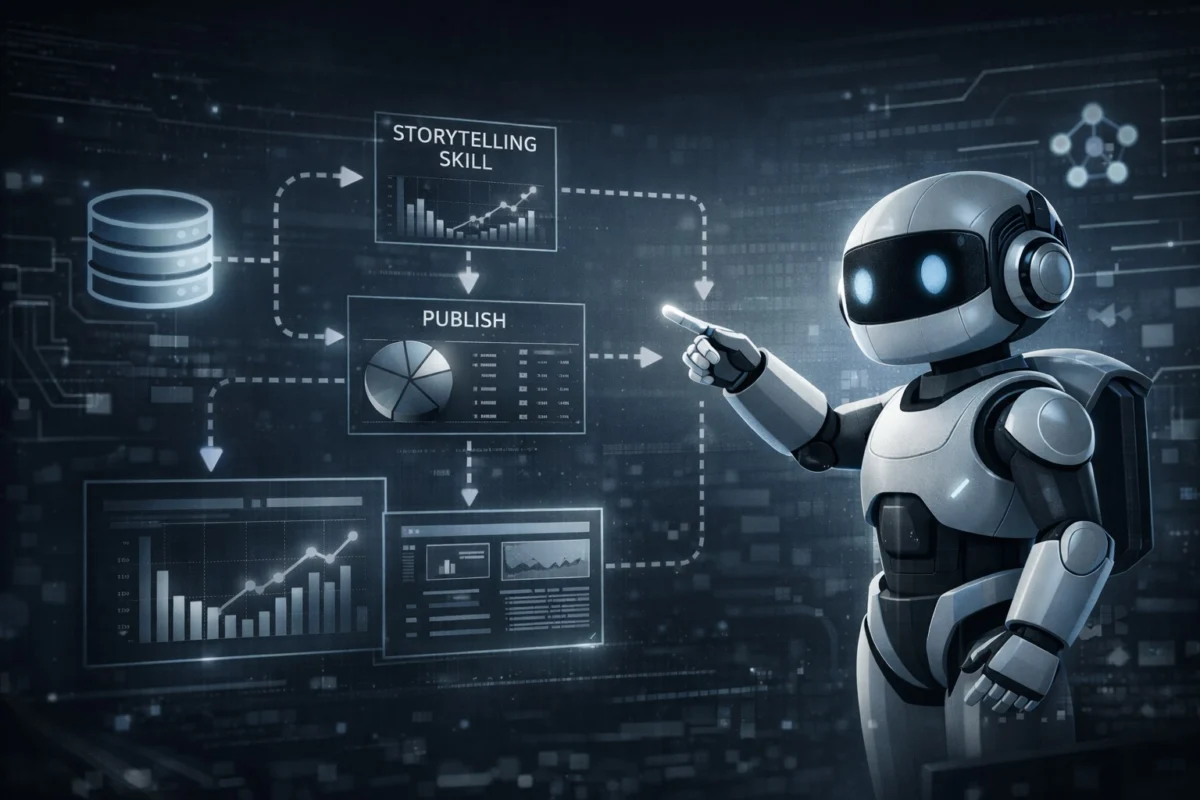
Unlocking the Full Data Science Workflow: How AI Skills Revolutionize Automation
In a significant advancement for data science professionals, the integration of Artificial Intelligence (AI) is moving beyond mere code generation to encompass the entirety of the data science workflow. This evolution is largely driven by the concept of "skills," reusable packages of instructions and supporting files designed to imbue AI with the ability to reliably and consistently execute recurring analytical tasks. This approach promises to streamline processes, reduce manual effort, and enhance the accuracy and depth of data-driven insights.

The foundational element of an AI skill is a SKILL.md file. This file contains essential metadata, including the skill’s name and a comprehensive description of its intended functionality. Critically, it outlines detailed instructions for how the AI should execute the skill. To further standardize and ensure accuracy, these skills are often bundled with complementary scripts, templates, and illustrative examples.
The rationale behind employing skills rather than embedding entire workflows directly into AI contexts, such as Claude Code or Codex, lies in efficiency and context management. By loading only the lightweight metadata initially, the AI can defer the processing of more extensive instructions and bundled resources until a skill is deemed relevant to the task at hand. This significantly shortens the primary context window, a crucial factor in managing computational resources and maintaining AI performance. A growing repository of these public skills can be found at skills.sh, offering a valuable resource for developers and data scientists looking to leverage this technology.

To illustrate the practical application of AI skills, consider a compelling use case: the automation of a weekly data visualization process. This process, often repetitive and time-consuming, has been a consistent challenge for many in the field.
The Weekly Visualization Challenge: From Manual Effort to AI Efficiency
For years, data scientists have dedicated time each week to create a single, insightful visualization. This practice, while valuable for maintaining analytical rigor and exploring data trends, can consume significant resources. For instance, a data scientist who has been producing one visualization per week since 2018 has generated over 330 unique visualizations. If each visualization takes approximately one hour to produce, this amounts to over 330 hours of dedicated work annually. This repetitive nature makes it an ideal candidate for automation through AI skills.

Traditionally, the weekly visualization workflow typically involved several distinct steps:
- Data Acquisition: Identifying and retrieving the relevant dataset from various sources, which could include databases, APIs, or flat files.
- Data Cleaning and Preprocessing: Ensuring the data is accurate, complete, and in a suitable format for analysis and visualization.
- Exploratory Data Analysis (EDA): Understanding the data’s characteristics, identifying patterns, and formulating hypotheses.
- Visualization Design: Selecting appropriate chart types, determining color palettes, labels, and overall aesthetic.
- Insight Generation: Interpreting the visualization to extract meaningful conclusions and actionable insights.
- Storytelling and Reporting: Communicating the findings effectively through written narratives and polished visuals.
This multi-step process, while yielding valuable outcomes, is prone to human error and can be time-intensive.

AI-Powered Visualization: A Paradigm Shift
By implementing AI skills, significant portions of this workflow can be automated. While the initial step of manually searching for the appropriate dataset might still require human intervention, subsequent stages can be effectively handled by AI. For example, two key skills can be developed: one for generating visualizations and another for crafting compelling narratives around them.
A practical demonstration of this AI-driven approach was recently showcased using the Apple Health dataset. In this scenario, a user tasked an AI system, such as Codex, with querying data from a Google BigQuery database. Subsequently, a specialized "storytelling-viz" skill was invoked. The AI was not only able to retrieve and analyze the data but also to surface a critical insight: the relationship between annual exercise time and calories burned. Crucially, the skill recommended a specific chart type, providing a clear rationale and outlining potential trade-offs, demonstrating a level of analytical reasoning.

The entire process, from data query to insight-driven visualization, reportedly took less than ten minutes. The output was a comprehensive package, featuring an insight-driven headline, an interactive visualization, important caveats, and the explicit mention of the data source. This rapid generation of high-quality, context-aware visualizations represents a substantial leap in efficiency compared to manual methods. Further examples of visualizations generated by this skill can be found in its dedicated GitHub repository.
The Construction of the "Storytelling-Viz" Skill: A Deep Dive
The creation of such a sophisticated AI skill is a multi-stage process that leverages the AI’s capabilities for planning, refinement, and learning.

Step 1: Collaborative Planning and Skill Genesis
The initial phase involves a collaborative planning session with the AI. The user articulates the weekly visualization workflow and the overarching goal of automation. This dialogue focuses on defining the technical stack, specifying requirements, and establishing clear criteria for what constitutes a "good" output. This iterative discussion allows the AI to generate an initial version of the skill.

A notable aspect of this process is that the SKILL.md file does not need to be meticulously crafted from scratch. Users can simply instruct the AI, such as Claude Code or Codex, to create a skill for their specific use case. The AI can then bootstrap an initial version, effectively utilizing a "skill to create a skill" mechanism. This significantly lowers the barrier to entry for skill development.
Step 2: Iterative Refinement and Knowledge Integration

The initial skill generated by the AI often represents only a partial realization of the desired outcome. In the case of the "storytelling-viz" skill, the first version was capable of generating visualizations but struggled with suboptimal chart choices, inconsistent visual styles, and a failure to consistently highlight the main takeaway. Bridging this gap, the remaining 90% of the desired functionality required iterative improvements.
Several key strategies were employed to achieve this refinement:

-
Personal Knowledge Integration: Over years of practice, data scientists develop unique visualization best practices and stylistic preferences. To ensure the AI adhered to these established patterns, the user shared their own visualization screenshots and detailed style guidance. The AI was then able to synthesize this information, summarize common principles, and update the skill’s instructions accordingly. This process effectively imbues the AI with domain-specific expertise.
-
Leveraging External Resources: The vast landscape of online resources dedicated to data visualization design offers a rich source of information. By prompting the AI to research superior visualization strategies from reputable sources and analyze similar public skills, the "storytelling-viz" skill incorporated broader perspectives. This external research enhanced the skill’s scalability and robustness, going beyond the user’s explicit knowledge.

-
Learning Through Rigorous Testing: Continuous testing is paramount for identifying areas requiring improvement. The "storytelling-viz" skill was subjected to testing with over 15 diverse datasets. This allowed for the observation of its behavior across various data types and complexities, and a critical comparison of its output against the user’s own visualizations. This empirical approach led to concrete, actionable updates. For example, testing revealed a need for:
- More Explicit Data Source Inclusion: Ensuring the data source was always clearly indicated in the output.
- Refined Font Selection: Adjusting font choices for better readability and aesthetic appeal.
- Standardized Color Palettes: Implementing consistent and accessible color schemes.
- Improved Insight Highlighting: Enhancing the skill’s ability to extract and prominently display key insights.
- Clearer Caveat Generation: Ensuring that limitations and assumptions were clearly articulated.
The latest iteration of the "storytelling-viz" skill is publicly available on GitHub, inviting community engagement and further development.

Identifying the Ideal Use Cases for AI Skills
The weekly visualization project serves as a powerful illustration, but the utility of AI skills extends to numerous recurring data science workflows. Skills are particularly valuable in situations characterized by:
- Repetitive Tasks: Workflows that are performed frequently and consistently.
- Semi-Structured Processes: Tasks that have a defined sequence of steps but allow for some variability.
- Domain-Specific Knowledge Dependence: Workflows that require specialized knowledge or adherence to particular methodologies.
- Complexity Beyond Single Prompts: Tasks that are too intricate or multifaceted to be effectively managed with a single, static AI prompt.
Furthermore, the modular design of skills offers significant advantages. If a workflow comprises multiple independent and reusable components, it is advisable to split these into separate skills. For instance, the weekly visualization process could be divided into a skill for generating the visualization and another for publishing it to a blog. This modularity enhances reusability across different workflows and simplifies maintenance.

The Synergy of Skills and MCP
The power of AI skills is amplified when combined with tools like the Multi-Command Prompt (MCP). MCP facilitates the seamless integration of external tools and services, enabling AI models to interact with them effectively. For example, using BigQuery MCP in conjunction with the visualization skill allowed for the generation of visualizations directly from BigQuery datasets within a single command. MCP ensures smooth access to external data sources and tools, while skills guide the AI in executing the appropriate process for a given task. This complementary relationship forms a potent combination for sophisticated AI-driven workflows.
The Enduring Value of the Weekly Visualization Project
Despite the significant automation achieved, the data scientist continues the weekly visualization practice. This persistence highlights a crucial distinction: automation frees up human capacity, it does not necessarily eliminate the value of the underlying activity. When initially conceived in 2018, the project’s goal was to enhance proficiency with Tableau. However, its purpose has evolved. It now serves as a ritual for exploring diverse datasets, honing data intuition and storytelling abilities, and cultivating a data-centric perspective on the world. For the practitioner, the emphasis has shifted from the tool to the process of discovery, a process that remains valuable even in the age of advanced AI. This ongoing commitment underscores that while AI can automate the "how," the "why" and the human element of exploration and insight remain central to the data science endeavor.



Related Posts

Unlocking Engineering Efficiency: A Deep Dive into Anthropic’s Claude Cowork for Enhanced Productivity
Uncertainty Quantification in Machine Learning: A Deep Dive into Evidential Deep Learning and Deep Evidential Regression