
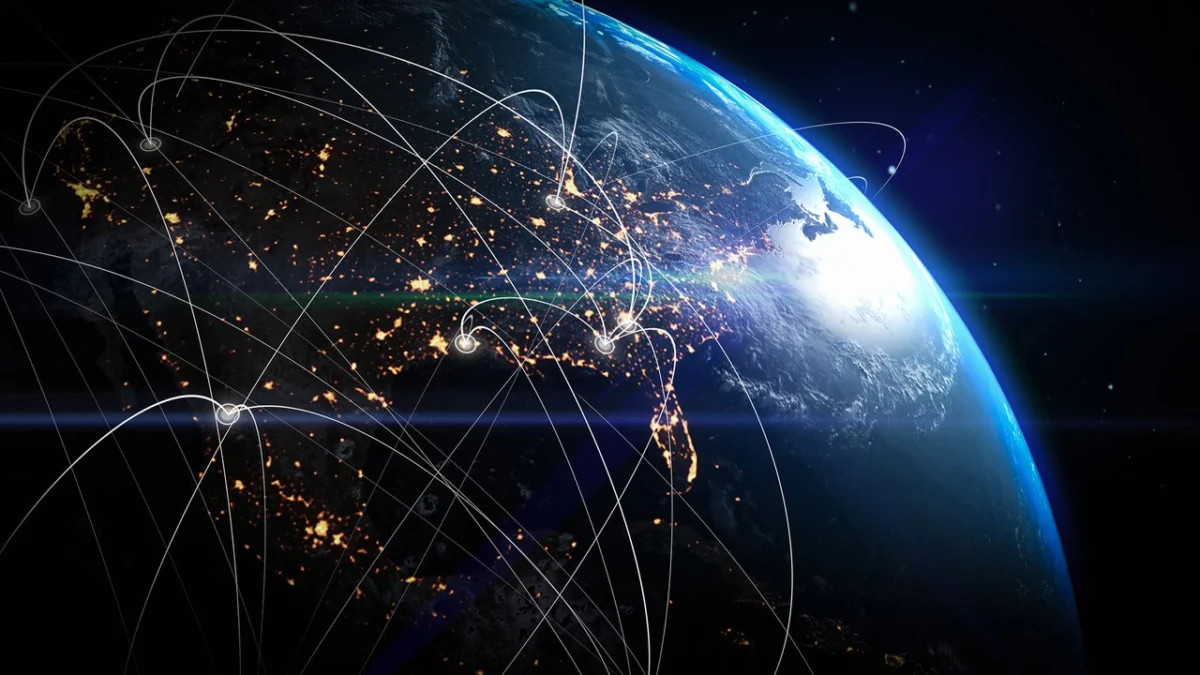
NASA’s Laser Communications Relay Demonstration Paves the Way for a Future of Ultra-Fast Space-Based Internet
In a remarkable display of technological advancement, astronauts aboard the International Space Station (ISS) in June 2024 engaged in an activity as common as sharing pet photos among office colleagues, but with an extraordinary twist: they were doing so from an altitude of 250 miles above Earth. Randy Bresnik, Christina Koch, and Kjell Lindgren participated in a demonstration using NASA’s Laser Communications Relay Demonstration (LCRD) system, successfully transmitting images at speeds approaching 1.2 Gigabits per second (GBits/sec). This achievement, while seemingly focused on personal connections, represents a significant leap forward in space-based communication, with profound implications for terrestrial internet infrastructure, scientific discovery, and future business networks.
The sheer speed of the LCRD transmission, over ten times faster than the average internet speeds of 50-100 Megabits per second (Mbits/sec) enjoyed by most users, underscores the potential of laser-based communication. This technology, a key component of NASA’s Space Communications and Navigation (SCaN) program, operates on principles similar to fiber optic internet on Earth, utilizing lasers to transmit data as rapid pulses of light representing binary code. The critical difference is the absence of physical cables, enabling communication across vast distances without the limitations of terrestrial infrastructure.
This pioneering work is not isolated. The Artemis II mission, which pushed the boundaries of human space exploration, also leveraged advanced laser communication. The Orion Artemis II Optical Communications System aboard the spacecraft successfully transmitted 4K video footage back to NASA at a rate of 260 Mbits/sec, even from the furthest human distance from Earth. This sustained high-bandwidth communication across immense interplanetary distances highlights the robustness and capability of laser communication technology, even under challenging environmental conditions.
The implications of these advancements extend far beyond the realm of space exploration. The development and deployment of such high-speed, reliable communication systems have the potential to revolutionize business operations, particularly in areas historically underserved by traditional internet infrastructure.
Transforming Business Networks: The Promise of Space-Based Broadband
The commercial applications of laser communication technology are vast and potentially transformative. As companies like SpaceX, with its Starlink constellation, and Amazon, with Project Kuiper, continue to expand their satellite networks, the vision of ubiquitous, high-speed internet access becomes increasingly tangible. These constellations aim to blanket the Earth’s surface with connectivity, promising to bring superfast broadband to rural areas, remote locations, and even airborne vehicles with unprecedented ease.
This could fundamentally alter the landscape of global business connectivity. For industries reliant on robust data transfer, such as finance, logistics, and remote collaboration, the ability to establish high-performance networks anywhere on the planet is a game-changer. The prospect of making subsea internet cables, the backbone of much of today’s global internet, potentially obsolete is a bold prediction, but one that large cloud providers like Google and Amazon might consider as they explore networking their globally distributed data centers via spaceborne transmitters.
Furthermore, the demand for low-latency internet services is escalating, particularly in high-frequency trading on stock markets where milliseconds can translate into significant financial advantages. A laser link from space could offer traders a competitive edge by providing a more direct and potentially faster data path compared to terrestrial routes that navigate geographical obstacles.
The security and resilience offered by laser-based communication also present compelling advantages for businesses and governments. Dedicated laser internet systems could establish highly secure, isolated networks resistant to hijacking and jamming. This capability is particularly crucial for military and governmental operations, enabling secure coordination of materiel movements, next-generation intelligence communications, and the safeguarding of critical national infrastructure.
In addition to security, laser internet offers a vital lifeline during terrestrial emergencies. Natural disasters such as earthquakes and hurricanes can devastate ground-based communication networks. A robust orbital network, unaffected by ground-level destruction, can ensure the continuity of essential communication lines for coordinating relief efforts and emergency services, a capability that has proven invaluable in numerous global crises.
Navigating the Challenges: Stumbling Blocks on the Path to Ubiquity
Despite the immense potential, the widespread deployment of laser internet faces several significant hurdles. Unlike radio frequency (RF) signals used in traditional satellite internet, which can broadcast in multiple directions and penetrate certain atmospheric conditions, laser beams require a precise, direct line of sight with their receivers. This necessitates a complex network of ground stations or relay satellites to ensure continuous connectivity as the Earth rotates.
The LCRD experiment itself highlighted the complexities of maintaining this line of sight. David Israel, Chief Architect of NASA’s Near Space Network and LCRD Principal Investigator, noted that even the solar panels on the ISS could sometimes obstruct the signal, illustrating the challenges of precise targeting. "If you just have one telescope using [a] very specific line of sight it’s very difficult," he explained. "We don’t have the equivalent of antennas that broadcast in all directions."
The Earth’s atmosphere presents another formidable challenge. While RF signals can be amplified to overcome atmospheric interference, laser beams are susceptible to scattering and obstruction by clouds, wildfire smoke, general pollution, and fog. These elements can degrade signal quality, potentially reducing internet speeds to dial-up levels.
The upper atmosphere, described by Jason Mitchell, Principal Technologist for Communications and Navigation at NASA, as a "constantly moving soup," also introduces variability. Dramatic changes in the atmosphere’s refractive index can affect the path and quality of a light beam.
Perhaps the most surprising obstacle is the issue of scheduling and orbital mechanics. LCRD, for instance, utilized a geosynchronous orbit to maintain a consistent position over transmitting and receiving stations. However, many space communication initiatives rely on the limited orbital windows when satellites are in view of ground stations. Achieving truly global coverage requires a vast and expensive constellation of satellites, a feat currently only within reach of entities like SpaceX with its thousands of Starlink satellites.
NASA is actively exploring solutions to these challenges. Israel discussed the concept of a "smart network" that dynamically routes data through nodes experiencing optimal conditions, avoiding clouds and rerouting to alternative orbiters or ground stations. This intelligent routing, operating at the speed of light, allows data to "bounce around the world until it finds a transmitter that can see the receiver clearly."
Furthermore, techniques are being developed to maintain and "clean up" laser signals. Mitchell elaborated on methods for re-centering and refocusing the beam, compensating for atmospheric distortions and wavefront variations. Advanced coding, modulation, and other signal processing techniques can remarkably preserve data fidelity despite apparent signal instability.
The Dawn of a New Era: Future of Space-Based Internet and Scientific Discovery
While the popular narratives surrounding NASA’s commercial spin-offs often include items like Tang, memory foam, and scratch-resistant sunglass lenses (some of which are apocryphal), the LCRD was born out of a pure pursuit of scientific discovery. Its precursor mission, the Deep Space Optical Communications (DSOC) experiment, achieved remarkable data transfer rates. In a single pass, DSOC transmitted 4.7 Terabits (Tbits) of information to a receiver at 257 Mbits/sec over four hours. This dwarfs the data return of the 1990s Magellan mission to Venus, which yielded approximately 1.2 Tbits over its entire five-year journey. DSOC essentially sent nearly four times as much data almost 8,000 times faster in a single orbital pass.
"What new discoveries could be made with such communications capability?" Mitchell pondered, underscoring the potential for revolutionary advancements in scientific research enabled by this high-bandwidth communication.
The economic viability of laser internet for commercial applications hinges on its return on investment. While the immediate replacement of existing infrastructure like 5G towers or terrestrial phone exchanges is unlikely in the near future, the underlying technology is surprisingly accessible. The transmitter, a laser generator affixed to a telescope at an observatory, is not fundamentally different from the components used in current fiber optic internet systems. Crucially, the receiver on the ISS, described as enabling "bits going in and out" with a "fiber optic connection through amplifier," functions remarkably like an everyday modem, with no significant modifications to commercial units required.
Israel acknowledges that widespread adoption of individual rooftop dishes for laser internet is not imminent. However, he foresees significant applications in satellite systems, telecommunications hub buildings, and gateways equipped with large antennas strategically pointed at various satellites. These centralized hubs would serve as critical nodes in a future laser-based communication network.
Laser internet may not yet be commonplace, but it is firmly moving from the realm of science fiction into tangible reality. While its immediate impact on consumer-level video conferencing might be some time away, its capacity to supercharge our understanding of the universe and provide resilient, high-speed connectivity for critical applications is undeniable. As NASA continues to push the boundaries of space-based communication, the future of global internet access and scientific exploration appears increasingly luminous.
Related posts:




Related Posts

Liverpool FC Leverages Wasabi’s Cloud Storage to Supercharge Digital Engagement and On-Pitch Success

The Hidden Cost of Outdated Technology: Employee Experience and Retention Under Threat