Ambassador Jamieson Greer Tours Michigan and Ohio Manufacturing Facilities to Highlight Success of National Tariff Program and Industrial Reshoring
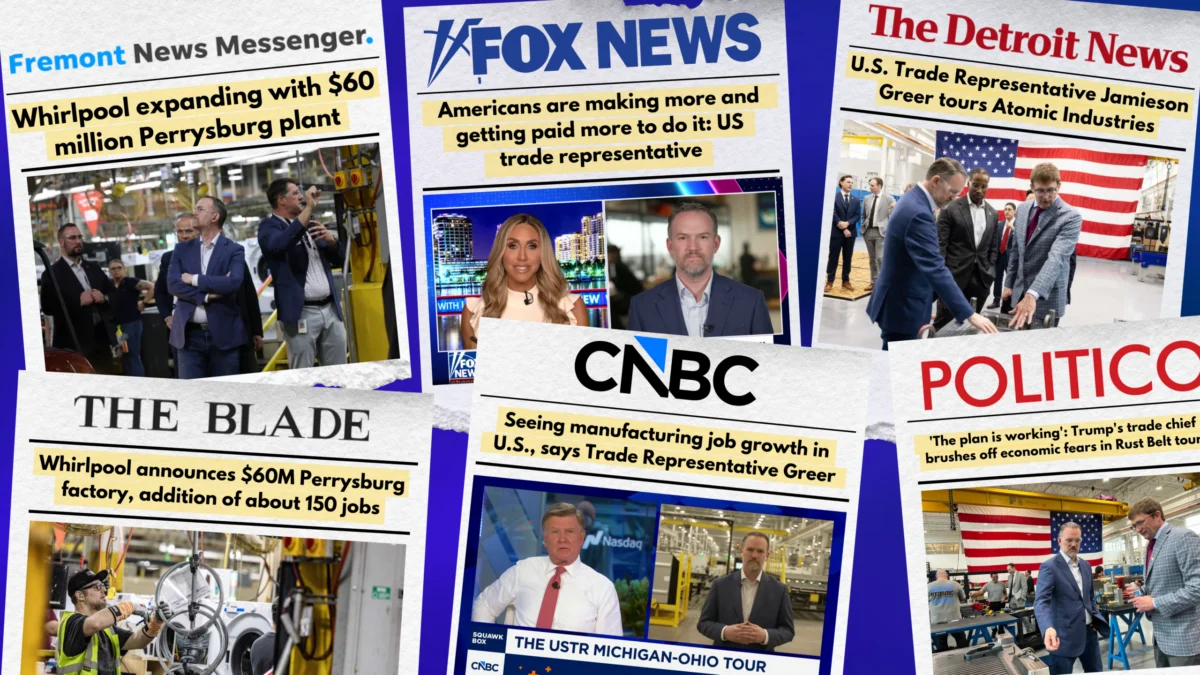
United States Trade Representative Ambassador Jamieson Greer concluded a multi-day diplomatic and industrial tour across the American Midwest last week, visiting key manufacturing hubs in Michigan and Ohio to evaluate the progress of the administration’s aggressive trade and tariff policies. The tour, which spanned several high-output industrial corridors, was designed to provide the executive branch with a first-hand assessment of how the current tariff regime is influencing domestic production, labor relations, and capital investment. During his visits to facilities ranging from advanced drone manufacturing plants to massive consumer appliance factories, Ambassador Greer engaged with a broad spectrum of stakeholders, including frontline blue-collar workers, representatives from major labor unions, and executive industry leaders. The primary focus of these discussions centered on the revitalization of the American industrial base, the logistical shift of reshoring production lines from overseas, and the measurable rise in domestic wages attributed to the protection of American markets.
The Ambassador’s itinerary began in Michigan, a state that has long served as the heart of American heavy industry and is currently undergoing a technological transformation. One of the primary stops was a state-of-the-art drone production facility, which represents the administration’s push to secure emerging technology supply chains. As unmanned aerial systems (UAS) become increasingly critical for both commercial logistics and national defense, the shift toward domestic production has been identified as a top priority for the Trump Administration. Ambassador Greer walked the production lines, observing the integration of automated assembly with skilled technical labor. He noted that the tariffs placed on foreign-made electronics and specialized components have incentivized these firms to source materials locally or within allied trade blocs, thereby reducing the vulnerability of the U.S. supply chain to foreign disruptions.
Following the Michigan leg of the tour, Ambassador Greer traveled to Ohio, where he visited what is recognized as the world’s largest washing machine manufacturing plant. This facility, a cornerstone of the regional economy, has become a symbol of the broader trade debate over the last decade. In discussions with plant management and floor supervisors, Greer reviewed data indicating that the imposition of targeted tariffs on imported white goods has allowed domestic manufacturers to reclaim significant market share. The Ambassador highlighted that the stability provided by these trade barriers has encouraged the company to commit to long-term capital investments, including the installation of new, high-efficiency assembly lines that require a more specialized—and higher-paid—workforce.
The Strategic Framework of Reindustrialization
The visit comes at a pivotal moment for U.S. trade policy. The Trump Administration has consistently argued that the erosion of the American manufacturing sector was not an inevitable consequence of globalization, but rather the result of predatory trade practices by foreign competitors and a domestic policy environment that favored outsourcing. By utilizing Section 232 and Section 301 tariffs, the administration aims to create a "price floor" that protects American goods from being undercut by state-subsidized foreign products. Ambassador Greer emphasized that these measures are not merely punitive but are designed as catalysts for systemic change.
“Manufacturing plants are the bedrock of communities across our country, fueling local economies and supporting workers and their families,” Ambassador Greer stated during a press briefing held on a factory floor in Ohio. “President Trump is using tariffs to accelerate America’s reindustrialization by incentivizing companies and countries to invest and build on American soil. The Trump Administration will continue to eliminate trade barriers to level the playing field for American workers and businesses, boosting our global competitiveness while expanding our manufacturing footprint.”
This sentiment was echoed by industry leaders who joined the Ambassador during the tour. Many CEOs noted that while the transition back to domestic manufacturing involves initial costs, the long-term benefits of reduced shipping times, higher quality control, and the elimination of geopolitical risk outweigh the short-term hurdles. Furthermore, the presence of labor union representatives during the tour underscored a rare point of alignment between organized labor and the executive branch regarding the necessity of protecting domestic jobs from international wage suppression.
Chronology of the Industrial Tour
The Ambassador’s tour was structured to highlight different sectors of the manufacturing economy, providing a comprehensive look at the "new" and "traditional" faces of American industry.
- Day One: Detroit and Ann Arbor, Michigan: The tour commenced with a focus on high-tech manufacturing. Greer met with startups and established firms in the aerospace and robotics sectors. The discussions focused on how tariffs on high-tech imports have allowed American innovators to secure venture capital for domestic production facilities rather than licensing their technology to overseas manufacturers.
- Day Two: Grand Rapids and Lansing, Michigan: The focus shifted to automotive components and heavy machinery. Greer met with representatives from the United Auto Workers (UAW) to discuss the impact of trade policy on collective bargaining. Union leaders pointed out that the reshoring of parts manufacturing has increased their leverage in securing better benefits and wage escalations for their members.
- Day Three: Clyde and Marion, Ohio: The Ambassador visited the massive appliance manufacturing corridor. This segment of the trip was dedicated to large-scale consumer goods. Greer observed the massive scale of production, where thousands of units are moved daily, and held a roundtable with local mayors to discuss how the resurgence of these plants has revitalized local tax bases and funded municipal infrastructure projects.
- Day Four: Columbus and Youngstown, Ohio: The final leg of the tour focused on the "Steel Valley" and the revitalization of metalworking. Greer toured steel processing centers that have seen a resurgence in demand due to the increased requirements for American-made steel in domestic construction and manufacturing projects.
Supporting Data: The Economic Impact of Reshoring
Economic indicators released in tandem with the Ambassador’s tour suggest a significant shift in the U.S. industrial landscape. According to recent data from the Department of Commerce and the Bureau of Labor Statistics, the manufacturing sector has seen a marked uptick in several key metrics over the last fiscal cycle:
- Job Creation: Since the implementation of the expanded tariff program, Michigan and Ohio have collectively added an estimated 45,000 manufacturing jobs. These positions are often characterized by higher-than-average entry-level wages compared to the service sector.
- Capital Expenditure (CAPEX): Investment in new plant and equipment by domestic manufacturers has risen by 14% year-over-year. This indicates that companies are not just maintaining existing operations but are betting on the long-term viability of U.S.-based production.
- Trade Deficit Reduction: In specific categories covered by the tariffs, such as household appliances and certain classes of industrial machinery, the trade deficit has narrowed by nearly 18%, as domestic production replaces imports.
- Wage Growth: Real wages for blue-collar workers in the Midwest manufacturing belt have grown by 5.2% over the past 12 months, outpacing inflation and the national average for wage growth in other sectors.
These figures serve as the statistical backbone for the administration’s claims that trade protectionism, when applied strategically, does not lead to stagnation but rather to a robust internal market. Critics of the policy have frequently warned of increased consumer prices; however, Ambassador Greer argued that the increase in domestic competition and the reduction in global shipping costs have helped to stabilize prices for American consumers in the long run.
Official Responses and Stakeholder Reactions
The reaction to Ambassador Greer’s tour from the industrial sector has been largely positive, though tempered by calls for continued support in workforce development. A spokesperson for the Michigan Manufacturers Association stated, "The focus on reshoring is a welcome change for our members. However, as we bring these production lines back to the U.S., we face a significant ‘skills gap.’ We are working closely with the administration to ensure that trade policy is matched by robust investment in vocational training and apprenticeships."
Labor leaders also expressed a cautious optimism. A representative from the local UAW chapter in Michigan noted that while the tariffs have undoubtedly saved jobs that were on the verge of being moved to Mexico or Southeast Asia, the long-term success of the program depends on ensuring that the "new" manufacturing jobs offer the same level of security and benefits as the industrial jobs of the mid-20th century.
On the legislative front, proponents of the administration’s trade policy in Congress have used the tour to drum up support for further "Level the Playing Field" legislation. This proposed legal framework would seek to automate certain tariff adjustments based on foreign currency manipulation and environmental standards, ensuring that American manufacturers are not disadvantaged by countries with lower regulatory burdens.
Broader Implications and Global Trade Dynamics
Ambassador Greer’s tour is more than a domestic victory lap; it is a signal to the global market that the United States is committed to a "producer-centric" rather than a "consumer-centric" economic model. This shift has profound implications for global trade dynamics. By prioritizing the industrial base, the U.S. is effectively signaling the end of the era of unfettered neoliberal globalization.
The emphasis on drone manufacturing, in particular, highlights the intersection of trade policy and national security. By ensuring that critical technologies are built within the U.S., the administration is mitigating the risk of "backdoor" vulnerabilities in hardware and software that can occur when manufacturing is outsourced to adversarial nations. This "securitization of trade" is expected to be a defining feature of American foreign policy through the remainder of the decade.
Furthermore, the success of the Michigan and Ohio manufacturing corridors serves as a domestic proof-of-concept for the administration’s broader economic agenda. If the "Rust Belt" can be successfully rebranded as a "Tech and Industrial Belt," it provides a political and economic template for other regions of the country, such as the Southeast and the Pacific Northwest, to pursue similar reindustrialization strategies.
As Ambassador Greer returns to Washington, the insights gathered from the factory floors of the Midwest are expected to inform the next round of trade negotiations and executive actions. The administration has indicated that it will continue to monitor the impact of tariffs on a sector-by-sector basis, with the possibility of expanding duties to other categories of imported goods that are deemed essential to the American industrial ecosystem. For now, the message from Michigan and Ohio is clear: the American factory is back, and the government is prepared to use every tool in its trade arsenal to ensure it stays that way.

Related Posts

Strengthening Economic Ties Across the Pacific: A Deep Dive into U.S. Trade Relations with APEC Member Economies
Successful Conclusion of the United States–United Kingdom Arrangement on Pharmaceutical Pricing