





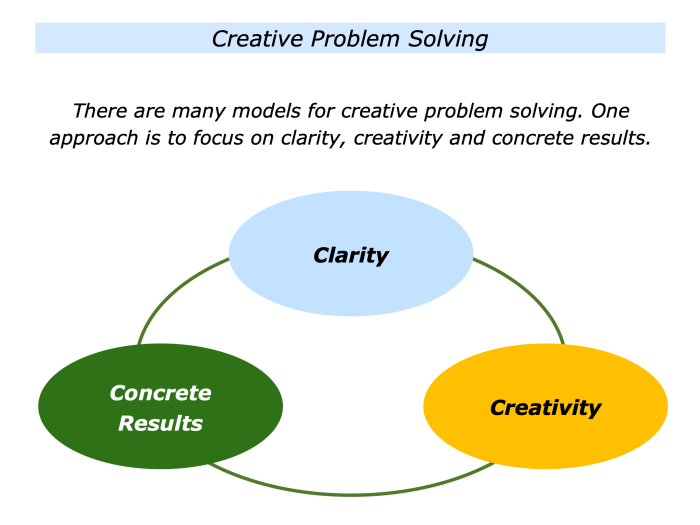
Approach to solving problems is a crucial skill in every aspect of life, from personal dilemmas to complex business challenges. This guide delves into various methodologies, from analytical and creative problem-solving strategies to the practical application of specific tools and techniques. We’ll explore the stages of the problem-solving process, how critical thinking and communication enhance effectiveness, and even consider the role of technology in modern problem-solving.
This exploration covers everything from defining different approaches to understanding the iterative nature of problem-solving. We’ll examine how problem-solving differs across various fields and how decision-making plays a crucial part. Learn how to apply these concepts to your daily life, work, or any situation that requires overcoming challenges.
Defining Problem-Solving Approaches
Problem-solving is a crucial skill in all aspects of life, from personal dilemmas to complex business challenges. Effective problem-solving relies on a range of approaches, each with its own strengths and weaknesses. Understanding these approaches allows individuals and teams to select the most suitable strategy for a given situation, leading to more efficient and effective outcomes.Different problem-solving approaches often yield varying results.
A structured, systematic approach might be ideal for complex technical issues, while a more creative approach could be better suited for brainstorming innovative solutions to unique challenges. Recognizing the nuances of each method is key to successful problem resolution.
Analytical Problem-Solving
Analytical problem-solving emphasizes a systematic and logical process for identifying and resolving issues. It involves breaking down complex problems into smaller, more manageable parts, examining each component, and then developing a solution based on evidence and data. A critical aspect of this approach is data collection, analysis, and evaluation to identify patterns and root causes.
Creative Problem-Solving
Creative problem-solving focuses on generating diverse ideas and solutions. It often involves brainstorming, lateral thinking, and considering unconventional perspectives. The goal is to explore a wide range of possibilities, even those that seem improbable at first glance. This approach is particularly valuable when dealing with novel or ill-defined problems.
Systematic Problem-Solving
Systematic problem-solving involves a structured methodology, often following a predefined sequence of steps. This approach provides a clear framework for approaching problems, ensuring a thorough investigation and comprehensive solution. Common examples include the scientific method or project management methodologies. This approach is often preferred in technical fields or when strict adherence to procedure is essential.
Adaptive Problem-Solving
Adaptive problem-solving acknowledges that problems often arise in dynamic and unpredictable environments. It emphasizes flexibility and adaptability in adjusting problem-solving strategies to accommodate changing circumstances. This approach requires continuous monitoring of the problem, evaluation of evolving information, and the willingness to adjust the solution as new information emerges. This is especially critical in complex and evolving situations.
Sometimes, the best approach to solving problems isn’t a head-first dive into solutions, but a step back. Reflecting on my future self, as in a letter to my 50 year old self on grace and getting older, a letter to my 50 year old self on grace and getting older , helps me appreciate the importance of patience and grace.
This perspective ultimately allows for a more thoughtful, less reactive approach to any challenge.
Comparison of Problem-Solving Approaches
| Approach | Key Characteristics | Strengths | Weaknesses |
|---|---|---|---|
| Analytical | Systematic, logical, data-driven | Precise, reliable, often yields optimal solutions | Can be slow, may miss creative solutions, requires substantial data |
| Creative | Innovative, diverse ideas, unconventional | Leads to novel solutions, fosters imagination | May lack structure, difficult to evaluate ideas objectively |
| Systematic | Structured, step-by-step process | Provides a clear framework, ensures thorough investigation | Can be rigid, may not be adaptable to changing circumstances |
| Adaptive | Flexible, responsive to change | Effective in dynamic environments, accommodates new information | May require significant time to adjust, potentially less optimal solutions |
Stages of Problem Solving
Problem-solving is a multifaceted process, not a linear progression. Understanding the stages involved allows for a more structured and effective approach, even if the exact order isn’t always strictly followed in practice. Recognizing the iterative nature of these stages is key to achieving successful outcomes.
Defining the Problem
Identifying the core issue is paramount. A vague or poorly defined problem can lead to ineffective solutions. This stage involves meticulous analysis of the situation, gathering information from various sources, and clarifying the problem statement. A precise problem statement clearly articulates the issue, its impact, and the desired outcome. For example, if a company’s sales are declining, the problem statement might be: “To identify the cause of declining sales in the Q3 2024 period and implement strategies to recover the market share.” This concise statement pinpoints the specific area of concern and the objective.
Generating Potential Solutions
Brainstorming a wide range of potential solutions is critical. This phase encourages creativity and exploration of diverse approaches. Techniques like brainstorming, mind mapping, and lateral thinking can be employed to generate multiple options. During this stage, it’s crucial to encourage a non-judgmental environment where all ideas are welcomed. For instance, when a team is facing a production bottleneck, they might brainstorm solutions like re-allocating resources, implementing new technology, or outsourcing certain tasks.
This phase should be inclusive and encompass a broad spectrum of possibilities.
Evaluating Solutions
Analyzing the potential solutions generated in the previous stage is vital. This involves assessing the feasibility, cost-effectiveness, and potential risks associated with each option. Factors such as resource availability, time constraints, and potential consequences should be carefully considered. Using a decision matrix or scoring system can help in systematically evaluating and comparing the solutions. For example, if the solution involves implementing new software, the evaluation might include the cost of the software, the time needed for training, and the potential impact on existing processes.
A key approach to solving any problem, big or small, is to break it down into manageable steps. Just like how wealthy people strategize their finances, as detailed in this insightful article about wealthy people save money like this , it’s often the meticulous planning and consistent execution that lead to success. This same principle applies to tackling any challenge – from fixing a leaky faucet to conquering a complex project at work.
Selecting a Solution
Based on the evaluation, a solution is chosen. The selection process considers the most viable and effective approach. The decision should align with the problem statement and consider the resources available and the potential impact on the stakeholders. Criteria such as feasibility, cost, and potential risks should guide the decision-making process. For instance, after evaluating several solutions to address a customer service backlog, the team might choose to implement a new ticketing system, given its positive impact on efficiency and cost-effectiveness.
Implementing the Solution
This stage involves putting the chosen solution into action. It requires careful planning, resource allocation, and execution. A clear plan of action outlining tasks, timelines, and responsibilities should be established. Communication and collaboration are essential to ensure smooth implementation. For instance, when implementing a new marketing strategy, the team would need to allocate resources for advertising, design, and execution.
Monitoring and Evaluating Results
The final stage involves monitoring the implemented solution and evaluating its effectiveness. This involves tracking key metrics, collecting feedback, and making necessary adjustments. The results of the solution implementation should be compared against the desired outcomes Artikeld in the problem statement. If the solution isn’t meeting expectations, adjustments should be made to the process. For example, after implementing a new customer service training program, the team might monitor customer satisfaction scores and adjust the training curriculum based on the feedback received.
Problem Solving Flow Chart
[Insert a visual flow chart here. The flow chart should depict the stages of problem solving, including feedback loops and potential re-evaluation of stages. It should clearly show the sequential nature of the stages and the potential for overlap in real-world scenarios. For example, after implementing a solution, the evaluation might reveal the need to revisit the problem definition stage.
]
Tools and Techniques for Problem Solving
Problem-solving is a multifaceted process, and the right tools and techniques can significantly improve its efficiency and effectiveness. Different approaches are more suitable for specific types of problems, and understanding these tools empowers you to choose the most appropriate one for a given situation. This section will explore various tools and techniques, highlighting their application, strengths, and limitations.
Problem-Solving Tools and Techniques
A diverse range of tools and techniques can be employed in problem-solving, from simple brainstorming to more complex analytical methods. Selecting the right tool is crucial for achieving a desired outcome. This section provides a concise overview of key tools and their applications.
| Tool Name | Description | Application |
|---|---|---|
| Brainstorming | A group discussion technique designed to generate a large number of ideas quickly and without initial criticism. | Effective for generating creative solutions to complex problems, identifying potential causes, and exploring alternative perspectives. Useful in initial stages of problem definition. |
| Root Cause Analysis | A systematic approach to identify the underlying causes of a problem, rather than just its symptoms. Common methods include the 5 Whys and Fishbone diagrams (Ishikawa diagrams). | Crucial for preventing recurring problems. Helpful in manufacturing, quality control, and any process where identifying the source of a problem is vital. |
| Decision Matrix | A structured method for evaluating and comparing multiple options based on predetermined criteria. | Ideal for situations with multiple alternatives and measurable criteria. Useful for selecting the best option from a set of choices, such as selecting a vendor or choosing a project strategy. |
| Flowcharts | Visual representations of a process or system, showing the steps involved and their relationships. | Useful for understanding processes, identifying bottlenecks, and improving efficiency. Applicable in project management, business processes, and technical problem-solving. |
| SWOT Analysis | A framework for evaluating the Strengths, Weaknesses, Opportunities, and Threats related to a problem or situation. | Useful for understanding the internal and external factors influencing a problem, facilitating strategic planning and decision-making. |
| 5 Whys | A technique for repeatedly asking “why” to uncover the root cause of a problem. | Effective in identifying the underlying reasons behind a problem by drilling down to the core cause. Useful in troubleshooting and problem diagnosis. |
Effectiveness and Limitations
The effectiveness of a problem-solving tool depends heavily on the context. Brainstorming, for instance, works best in a collaborative environment with a focus on quantity over quality in the initial stages. However, it might not be suitable for situations demanding precise analysis. Similarly, a Decision Matrix provides a structured approach, but it relies on clearly defined criteria and readily available data.
Therefore, careful consideration of the problem’s nature and available resources is essential when selecting a tool.
Critical Thinking and Problem Solving
Critical thinking is a cornerstone of effective problem-solving. It’s not just about finding answers; it’s about understanding the complexities of a problem, evaluating different approaches, and making reasoned judgments. This crucial skill set allows us to navigate challenges with greater efficiency and creativity, leading to more sustainable and impactful solutions.Critical thinking skills significantly enhance the problem-solving process by enabling a deeper understanding of the problem’s root causes and potential consequences.
This proactive approach allows individuals to identify and analyze various factors influencing the problem, fostering a more comprehensive and well-rounded perspective. This detailed understanding facilitates the development of more effective and innovative solutions.
The Connection Between Critical Thinking and Problem Solving
Critical thinking is intrinsically linked to effective problem-solving. It provides the framework for systematically analyzing information, identifying biases, and evaluating potential solutions. Without critical thinking, problem-solving often becomes reactive and potentially flawed. The ability to critically assess information and identify logical fallacies is paramount in avoiding errors and ensuring the best possible outcomes.
How Critical Thinking Skills Enhance the Problem-Solving Process
Critical thinking skills empower individuals to approach problems with a more systematic and analytical mindset. This involves questioning assumptions, evaluating evidence, and considering alternative perspectives. This rigorous process helps avoid impulsive decisions and promotes a more thorough exploration of potential solutions. By encouraging a deeper understanding of the problem’s context, critical thinking fosters more creative and adaptable solutions.
The Importance of Questioning Assumptions and Evaluating Information
Problem-solving often hinges on assumptions, but these assumptions must be critically examined. Blindly accepting information without questioning its validity or source can lead to flawed conclusions and ineffective solutions. Thorough evaluation of information, considering different viewpoints, and identifying potential biases is crucial to achieving accurate and reliable results.
Critical Thinking Questions for Problem Solving
A structured approach to questioning during the problem-solving process enhances the quality of solutions. These questions are designed to stimulate deeper analysis and a more comprehensive understanding of the issue.
- What are the underlying assumptions driving this problem?
- What evidence supports or contradicts these assumptions?
- What are the potential consequences of each potential solution?
- What alternative perspectives or solutions might exist?
- Are there any potential biases or limitations in the available data?
- How can the problem be framed in different ways to explore new avenues?
- What are the potential long-term implications of the chosen solution?
- How can this problem be approached from a systems perspective, recognizing interconnectedness?
- Are there any ethical considerations that need to be addressed in the problem-solving process?
By actively engaging with these questions, problem-solvers can develop a more nuanced understanding of the situation and make more informed decisions.
Creative Problem Solving

Unlocking innovative solutions often requires a departure from conventional thinking. Creative problem-solving is a multifaceted approach that goes beyond simply identifying the problem; it involves generating a multitude of potential solutions, even those that seem unconventional at first glance. It’s a journey of exploration and experimentation, leading to breakthroughs and advancements in various fields.Creative problem-solving is not just about brainstorming; it’s a structured process that can be learned and honed.
It involves cultivating a mindset that embraces ambiguity, encourages diverse perspectives, and fosters an environment where risk-taking and experimentation are valued. This approach is crucial for tackling complex challenges and finding innovative solutions that others might overlook.
Techniques for Fostering Creative Problem-Solving
A variety of techniques can be employed to stimulate creative thinking and unlock innovative solutions. These techniques encourage divergent thinking, pushing beyond the immediate and exploring a broader range of possibilities. They involve actively seeking out diverse perspectives and challenging assumptions.
- Brainstorming: This technique encourages the free flow of ideas without judgment. Participants are encouraged to generate as many ideas as possible, no matter how seemingly outlandish. This process often leads to unexpected connections and novel solutions.
- Mind Mapping: Visualizing connections between ideas can reveal unexpected relationships and generate new possibilities. This technique uses a central theme or problem and branches out to related concepts, allowing for a more comprehensive exploration of the issue.
- Lateral Thinking: This approach involves looking at problems from different angles and challenging assumptions. It encourages a shift in perspective to find innovative solutions by avoiding conventional thinking patterns.
- SCAMPER: This technique uses a series of prompts (Substitute, Combine, Adapt, Modify, Put to other uses, Eliminate, Reverse) to spark creativity and generate new ideas. It challenges existing solutions to generate alternatives.
- Role-Playing and Simulation: Putting oneself in the shoes of different stakeholders or imagining various scenarios can offer fresh insights and lead to more nuanced solutions.
Examples of Creative Problem-Solving in Action
Creative problem-solving has had a profound impact across numerous fields. It’s not limited to the theoretical; it’s a practical approach with tangible results.
- The development of the light bulb: Thomas Edison’s persistence in experimenting with different materials and designs exemplifies creative problem-solving. His relentless pursuit of a solution, despite numerous failures, ultimately led to a breakthrough.
- The invention of the personal computer: The development of the personal computer required a series of innovative solutions to integrate complex technologies into a user-friendly form factor. This process showcases the importance of creative problem-solving in bringing complex technology to the masses.
- Sustainable urban planning: Cities worldwide are using creative problem-solving to address issues like traffic congestion, pollution, and resource scarcity. This includes developing innovative transportation systems, promoting green spaces, and creating more efficient urban layouts.
Encouraging Innovative Ideas and Solutions
Creating an environment that fosters innovation is essential for achieving breakthroughs. This involves actively encouraging diverse perspectives and valuing creative solutions, even if they seem unconventional.
- Encourage open communication: Create a safe space for individuals to share ideas and feedback without fear of judgment. Foster a culture of constructive criticism and collaboration.
- Reward creativity: Recognize and reward individuals who come up with innovative solutions. This can incentivize others to embrace creative thinking and problem-solving.
- Embrace failure as a learning opportunity: View failures as valuable learning experiences rather than setbacks. Encourage experimentation and the willingness to try new approaches.
- Cultivate curiosity and a growth mindset: Encourage a mindset that embraces learning and challenges the status quo. Promote a willingness to explore new ideas and possibilities.
Overcoming Mental Blocks and Generating Diverse Perspectives
Creative blocks can hinder progress in problem-solving. Overcoming these blocks and generating diverse perspectives are essential for achieving truly innovative solutions.
- Techniques to overcome mental blocks: Employ techniques like brainstorming, mind mapping, and lateral thinking to challenge assumptions and explore alternative solutions. Engage in activities that stimulate creativity and break mental routines.
- Seeking diverse perspectives: Actively solicit input from individuals with different backgrounds, experiences, and viewpoints. This approach broadens the range of perspectives considered and leads to more comprehensive and innovative solutions.
Problem-Solving in Different Domains: Approach To Solving Problems

Problem-solving isn’t a one-size-fits-all approach. The best strategies and tools vary significantly depending on the field of application. From the calculated precision of engineering to the nuanced empathy of medicine, understanding the unique characteristics of each domain is crucial for effective problem resolution. This section delves into how problem-solving differs across various fields, highlighting the specific challenges and considerations in each.Effective problem-solving demands an understanding of the context in which the problem arises.
A business problem requires different considerations than an engineering or medical one. The methodologies employed and the tools utilized are often tailored to the unique characteristics of each domain. Knowing the specific hurdles and how different approaches can be applied to overcome these challenges is key to success.
Business Problem Solving
Business problem-solving often involves optimizing processes, improving profitability, or expanding market share. It’s characterized by a focus on efficiency, cost-effectiveness, and market trends. Decisions frequently need to be made under pressure, considering the impact on stakeholders and profitability. Resource allocation, market analysis, and competitor strategies are integral components of the process. Identifying the root causes of business issues, developing feasible solutions, and implementing them effectively are critical for success.
Engineering Problem Solving
Engineering problem-solving often involves designing, building, or improving technical systems. The emphasis is on precision, safety, and adherence to established standards and regulations. Mathematical models, simulations, and prototypes are frequently employed. Understanding physical laws, material properties, and potential risks is paramount. Thorough testing and evaluation are essential steps before implementation.
Medical Problem Solving
Medical problem-solving centers on patient care and well-being. It’s characterized by a focus on diagnosis, treatment, and preventive measures. Decisions must be made quickly and accurately while considering ethical and legal implications. Understanding patient history, medical conditions, and potential complications is crucial. Collaboration between healthcare professionals is essential for optimal patient outcomes.
Comparison of Problem-Solving Across Domains
| Domain | Key Characteristics | Common Challenges | Typical Tools & Techniques |
|---|---|---|---|
| Business | Efficiency, profitability, market trends | Resource constraints, stakeholder conflicts, market volatility | SWOT analysis, market research, financial modeling, cost-benefit analysis |
| Engineering | Precision, safety, adherence to standards | Material limitations, design constraints, testing complexities | Prototyping, simulations, FEA (Finite Element Analysis), CAD (Computer-Aided Design) |
| Medicine | Patient care, diagnosis, treatment | Limited information, ethical dilemmas, time constraints, patient variability | Medical history review, physical examination, diagnostic testing, clinical trials |
Effective Communication in Problem Solving
Effective communication is the lifeblood of successful problem-solving. It’s not just about exchanging information; it’s about fostering understanding, collaboration, and shared ownership of the problem. Clear and concise communication helps teams align on goals, identify root causes, brainstorm solutions, and ultimately implement effective strategies. Without robust communication, even the most brilliant ideas can get lost in translation, leading to wasted effort and unsatisfactory outcomes.Communication isn’t a passive process; it requires active listening, empathy, and a willingness to adapt to different styles.
A strong communication strategy is fundamental to navigating the complexities of problem-solving, regardless of the domain or the specific issue at hand. It bridges the gap between individuals, enabling teams to pool their resources and collective intelligence to find effective solutions.
The Role of Communication in Problem Solving, Approach to solving problems
Communication acts as the crucial link between individuals and teams involved in a problem-solving process. It enables the exchange of information, facilitates the understanding of perspectives, and promotes a shared understanding of the problem and its potential solutions. This shared understanding is critical for effective collaboration and collective decision-making. A strong communication framework ensures that everyone is on the same page, minimizing misunderstandings and fostering a sense of shared responsibility.
Importance of Clear and Concise Communication
Clear and concise communication is essential throughout the problem-solving process. Ambiguous or overly complex language can lead to misinterpretations, wasted time, and ultimately, ineffective solutions. Using precise language, avoiding jargon, and structuring messages logically all contribute to a more efficient and effective problem-solving process. This clarity is crucial in every stage, from defining the problem to implementing the solution.
For example, a vague statement about “customer dissatisfaction” needs to be precisely defined in terms of specific behaviors and measurable impacts.
Different Communication Styles and Their Impact
Different individuals possess unique communication styles. Understanding these styles and their potential impact on problem-solving is vital. Some individuals may be highly assertive and direct, while others may be more collaborative and indirect. A highly structured and methodical communicator might not be effective in a highly creative brainstorming session. Conversely, a highly creative person might find it difficult to present their ideas in a concise and organized manner.
Recognizing these differences and adapting communication styles accordingly can significantly improve problem-solving outcomes.
Sometimes, the best approach to solving problems is to step away and find inspiration elsewhere. For example, envisioning a relaxing escape to one of these stunning American campsites, like the ones featured in 15 gorgeous American campsites you should visit least once in your life , can spark fresh perspectives. Returning to your problem with a renewed sense of calm and creativity will often lead to a more effective solution.
Effective Communication Strategies
Effective communication strategies are key to successful problem-solving sessions. Active listening is paramount, allowing individuals to fully understand the perspectives of others. Encouraging open dialogue and constructive feedback is also important. Clear documentation of discussions, decisions, and action items ensures that everyone is on the same page and that progress is consistently tracked. Using visual aids, such as charts, diagrams, and presentations, can help convey complex information effectively.
Furthermore, regular check-ins and feedback loops are crucial to maintaining clarity and alignment throughout the process.
- Active Listening: Paying close attention to what others are saying, both verbally and nonverbally, and demonstrating understanding through verbal affirmations or paraphrasing. This fosters trust and ensures that everyone feels heard.
- Open Dialogue: Creating a safe space where individuals feel comfortable expressing their ideas and concerns without fear of judgment. This fosters a collaborative environment and encourages diverse perspectives.
- Constructive Feedback: Providing feedback that is specific, actionable, and focused on improvement rather than criticism. This promotes a growth mindset and enhances the problem-solving process.
- Visual Aids: Utilizing charts, diagrams, and presentations to convey complex information visually and to facilitate understanding. This is particularly helpful when presenting data or processes.
- Documentation: Maintaining detailed records of discussions, decisions, and action items. This serves as a valuable reference point and ensures accountability.
Problem-Solving and Decision Making
Problem-solving and decision-making are intricately linked processes. Effective problem-solving often hinges on sound decision-making, and vice-versa. Successful resolution of challenges frequently relies on the ability to analyze situations, identify viable options, and choose the most appropriate course of action. This interplay between problem-solving and decision-making is critical across various domains, from personal choices to complex business strategies.Decision-making is the core engine driving the problem-solving process.
It involves evaluating different courses of action, considering potential consequences, and selecting the best option to address the identified problem. By carefully considering alternatives, individuals and organizations can increase the likelihood of achieving desired outcomes and minimizing negative impacts. The quality of the decision directly influences the success of the problem-solving effort.
The Intertwined Nature of Problem-Solving and Decision-Making
Problem-solving often requires a series of decisions. From initial assessment of the situation to implementation and evaluation, each step typically involves a decision-making process. The quality of decisions directly affects the efficiency and effectiveness of the problem-solving process. A poor decision at any stage can derail the entire effort.
Impact of Decision-Making on the Problem-Solving Process
Decision-making impacts the problem-solving process in several key ways. First, decisions guide the selection of problem-solving strategies. Choosing a suitable approach based on the specific situation is crucial. Second, decisions determine the resources allocated to the problem-solving effort. Effective resource allocation is vital for successful implementation.
Finally, decisions influence the monitoring and evaluation of the problem-solving process. Continuous evaluation helps to ensure that the chosen solution is addressing the problem effectively.
Importance of Weighing Options and Evaluating Potential Outcomes
Thorough consideration of various options is paramount in effective decision-making. This involves understanding the potential benefits and drawbacks of each option, as well as anticipating possible outcomes. A comprehensive evaluation helps avoid unforeseen negative consequences and increases the likelihood of a favorable outcome. This careful consideration should involve analyzing the possible impacts on various stakeholders, not just the immediate beneficiaries.
For instance, a business decision to expand into a new market might yield increased profits but could also displace existing competitors or negatively affect the environment.
Steps in a Decision-Making Process During Problem-Solving
Understanding the decision-making process within problem-solving is essential. Careful consideration of each step improves the probability of reaching an effective solution. The steps, although seemingly linear, can be iterative and revisited throughout the process.
| Step | Description |
|---|---|
| 1. Define the Problem | Clearly articulate the problem to be solved. This involves identifying the root cause, affected parties, and desired outcome. |
| 2. Generate Possible Solutions | Brainstorm a range of possible solutions. This phase encourages creativity and diverse perspectives. Consider both conventional and innovative approaches. |
| 3. Evaluate Potential Outcomes | Analyze the potential benefits and drawbacks of each solution. Consider short-term and long-term consequences, as well as the impact on various stakeholders. |
| 4. Choose the Best Solution | Select the solution that best aligns with the defined problem and desired outcome, taking into account the evaluated potential outcomes. This is often a critical step involving weighing risks and rewards. |
| 5. Implement the Chosen Solution | Put the chosen solution into action. This may involve allocating resources, delegating tasks, and setting timelines. |
| 6. Monitor and Evaluate Results | Track the progress of the solution and assess its effectiveness in addressing the problem. This allows for adjustments and improvements as needed. |
Iterative Problem Solving
Iterative problem-solving is a cyclical approach to tackling complex issues. It recognizes that solutions often evolve and improve with ongoing analysis, feedback, and adaptation. This method embraces the reality that initial attempts may not perfectly address the problem, but through repeated cycles of refinement, the solution progressively becomes more effective. It’s a valuable approach in various domains, from software development to scientific research, to personal life.This approach acknowledges that problems are often multifaceted and require a dynamic response.
Initial solutions may not be optimal, and iterative refinement allows for adjustments and improvements based on evolving circumstances and insights. This continuous cycle of analysis, adaptation, and refinement leads to solutions that are more robust and tailored to the specific needs of the problem.
Understanding the Iterative Cycle
The iterative problem-solving process involves a continuous loop of steps. Each iteration builds upon the previous one, incorporating feedback and adjustments. This cyclical nature allows for a flexible and adaptable approach to problem-solving, crucial for complex issues that require a dynamic response.
Incorporating Feedback and Adaptation
Gathering and effectively using feedback is crucial for successful iterative problem-solving. Feedback can be obtained from various sources, including stakeholders, experts, and even the problem itself. The feedback analysis should be structured to identify areas for improvement and highlight potential shortcomings in the initial solution. Adaptation involves modifying the solution based on the feedback received. This might involve changing aspects of the solution, adding new features, or removing unnecessary components.
Refining Solutions Through Analysis and Evaluation
Regular analysis and evaluation are essential to ensure that solutions are progressing toward the desired outcome. This involves monitoring the impact of the solution, collecting data on its effectiveness, and assessing whether it meets the initial objectives. By continuously evaluating the solution, you can identify areas for improvement, make necessary adjustments, and ensure that the solution remains relevant and effective.
The evaluation should focus on measurable outcomes, comparing the current performance to the desired outcome.
Examples of Iterative Problem Solving in Action
- Software Development: Software development projects often employ iterative development methodologies like Agile. Developers create a basic version of the software, gather user feedback, and then adapt the product based on that feedback. This iterative process continues until the software meets the needs of the users.
- Scientific Research: Scientists use iterative experimentation to test hypotheses. An initial experiment may yield unexpected results, leading to adjustments in the methodology or the hypothesis itself. This process of refinement and adaptation is critical for advancing scientific knowledge.
- Personal Projects: Planning a renovation project, for example, could start with a basic design. Gathering feedback from family members and contractors, and considering budget constraints, the initial design is adapted and refined until a final, workable plan is achieved.
Problem-Solving and Technology
Technology has revolutionized problem-solving by providing powerful tools and resources for data analysis, communication, and collaboration. This has led to faster, more efficient, and often more effective solutions to complex challenges across various domains. The integration of technology allows for the processing of massive datasets, enabling deeper insights and more informed decision-making.Technology acts as a catalyst in the problem-solving process, streamlining every stage from initial identification to implementation.
Its ability to connect individuals and groups globally accelerates the sharing of knowledge and expertise, fostering a more collaborative and innovative approach.
The Role of Technology in Enhancing Problem-Solving Capabilities
Technology empowers problem-solvers by providing access to a vast repository of information, enabling faster and more thorough research. This readily available knowledge facilitates a deeper understanding of the problem’s context, contributing to more informed and effective solutions.
Facilitating Data Analysis
Technology plays a critical role in the analysis of large datasets, which are often encountered in modern problem-solving scenarios. Sophisticated software tools allow for the identification of patterns, trends, and correlations that might be missed by human observation alone. This analysis enables the development of more accurate models and predictions.
Facilitating Communication and Collaboration
Technology facilitates seamless communication and collaboration across geographical boundaries. Tools like video conferencing, instant messaging, and project management software enable real-time interaction and knowledge sharing, allowing individuals and teams to work together more effectively, irrespective of their location.
Examples of Technological Tools Used in Problem-Solving
A plethora of technological tools are employed in modern problem-solving. These tools range from simple spreadsheets for organizing data to sophisticated data visualization platforms. The appropriate tool selection depends on the nature of the problem and the desired outcome.
Technological Tools and Their Applications in Problem-Solving
- Spreadsheet software (e.g., Microsoft Excel, Google Sheets): Used for organizing and analyzing data, creating charts and graphs, and developing financial models. These tools are fundamental for data-driven problem-solving, allowing for the manipulation and visualization of large quantities of information.
- Database management systems (e.g., MySQL, PostgreSQL): Used to store, manage, and retrieve large amounts of structured data. These systems are crucial for complex problem-solving scenarios that involve significant data volumes, allowing for quick access to relevant information.
- Data visualization tools (e.g., Tableau, Power BI): Used to transform complex data into easily understandable visualizations, such as charts, graphs, and maps. These tools facilitate the identification of patterns, trends, and insights, accelerating the problem-solving process.
- Machine learning algorithms (e.g., in predictive modeling): Used to identify patterns and relationships in data that are not readily apparent to humans. These algorithms can analyze large datasets to forecast future trends and predict outcomes, thereby enabling proactive problem-solving.
- Project management software (e.g., Asana, Trello): Used to organize and track project tasks, deadlines, and dependencies. This helps ensure that team members work collaboratively and effectively, improving the efficiency of problem-solving processes.
- Cloud computing platforms (e.g., Amazon Web Services, Microsoft Azure): Used to store and process data, and access software tools, allowing for greater scalability and flexibility in problem-solving. This technology is particularly useful for handling large datasets and complex computational tasks.
Final Summary
In conclusion, mastering the approach to solving problems is an ongoing journey of learning and adaptation. By understanding different methodologies, utilizing effective tools, and cultivating critical thinking, we can navigate challenges more effectively. This guide provides a solid foundation for tackling problems in various domains, emphasizing the interconnectedness of different strategies. Remember, problem-solving is not a linear process; it’s a dynamic interplay of creativity, analysis, and communication.
Embrace the iterative nature of improvement and technology’s empowering role in your problem-solving arsenal.